The film 'The Fall' is one of the great works created by Tarsem Singh, an Indian film director. There are several reasons I want to call it a great work, and the very first reason is precisely 'color.'

Throughout the film he shows something like a certain domestic company's 'color project'; through various colors he shows the very peak of imagery in this film.
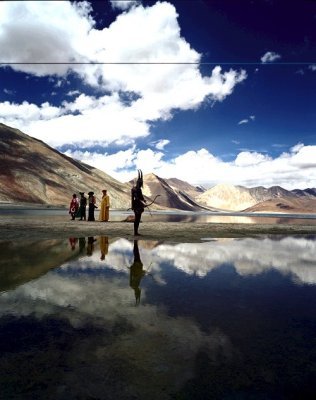
The 5 protagonists shown in the scene above hint that they will continuously express this film's color: the 'green' shown by the Indian, the 'brown' shown by the black man who had been a slave, the yellow shown by Luigi, the red and white shown by Charles Darwin, and the 'blue' of the Blue Bandit are the main colors. Showing each of their pasts briefly, one by one, as they band together for the common goal of 'Odious,' upon hearing the story that the 'Blue Bandit's' younger brother dies, they set out to dispatch 'Odious,' and right in the photo above they meet the 'magician' and go to meet Odious, but discover that the Blue Bandit's brother is already hanged and dead, and resolve to follow to the end and take revenge.
As a story Roy tells for Alexandria, he introduces the tale of 'Odious and the 6 warriors who seek revenge on him, and the nurse Evelyn,' calling it an 'epic of love and revenge'; Alexandria doesn't even know what the word 'epic' means, but since it's a story she enjoys listening and looks forward to it. So the film proceeds in a narrative style where two stories run in parallel, and the film's story flows back and forth between imagination and reality.
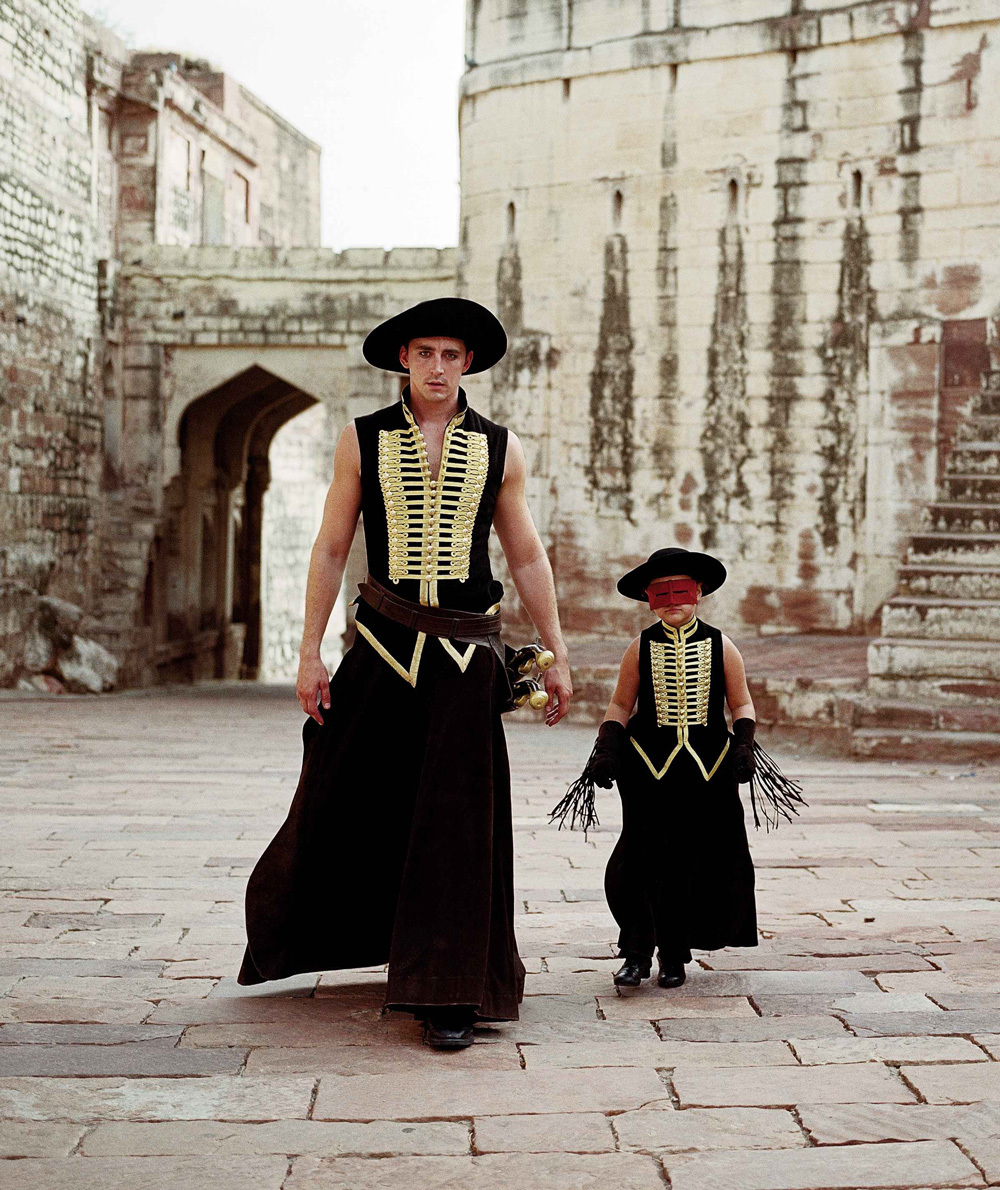
The way Roy and Alexandria simultaneously carry the story in two worlds is very beautiful and also fascinating. The way Alexandria is connected as the 'Blue Bandit's' daughter and appears wearing a mask is very cute and fascinating, and every single costume in this film feels as if it was designed for each individual character. In a way, this film may be expressing the importance of methods already in use for how one can construct a 'character.'
Roy, who had been a stuntman, becomes paralyzed in the lower body in an accident and, lying in bed, begins talking with Alexandria; at first you come to learn through several morphine errands that the reason he tells stories was to have her bring 'morphine.' The way he sends her on morphine errands many times and Alexandria secretly brings morphine from the dispensary and gives it to him shows the image of 'Roy' exploiting the cute Alexandria, but the way he later regrets it when an accident happens shows that it made him realize 'Alexandria' was a very precious being to Roy.
If the image of 'descent' shown in the prologue was sufficient to capture the despair that arose as Roy became paralyzed in the lower body from the accident, then the part at the film's ending that shows scene after scene of films in which he is active as a 'stuntman' shows that he has succeeded in rehabilitation and is once again actively working, that he is no longer falling into the 'abyss' but has succeeded in his comeback, contrastively showing that not only 'Alexandria' but he himself also recovered.
The part that proceeds toward the 'happy ending' Alexandria envisions is only the single scene in which, at the very moment she tearfully pleaded at the end, the 'Blue Bandit' strikes down Odious and rises. What this part means is that, in a film structure that must take a simple yet frame-narrative form called 'storytelling,' it shows that this is a style which, though the story is flimsy, often ends this way (you know, those tales your parents told you when you were little that suddenly drifted in a strange direction and ended. Of course, back then you didn't quite understand and just found it frustrating), and contributes to acquiring a 'naturalness' with a feeling you could often see in everyday life.
Tarsem Singh minimizes CG and shoots each and every cut of this film with maximum handcraft. His ability to compose shots, mixing long shots and close-ups appropriately, was a method that no film director I've ever seen while watching films had shown. The 'love-sharing' scene between Evelyn and the Blue Bandit, which used close-ups during lines and stepped up the long shots one stage at a time during the absence of lines, was very impressive and beautiful. The dress Evelyn wore is very beautiful, the white bird on her shoulder is cute, and as if in response, the costume the Blue Bandit wore and his 'prop' gun can only be described as magnificent.
I suppose for the time being there won't be a day when I can see a film like this. I'll have to pin my hopes on the thought that I should look up the Snow White of 'Tarsem Singh,' who is regarded as Hollywood's top visualist.
Comments 0
No comments yet. Be the first.