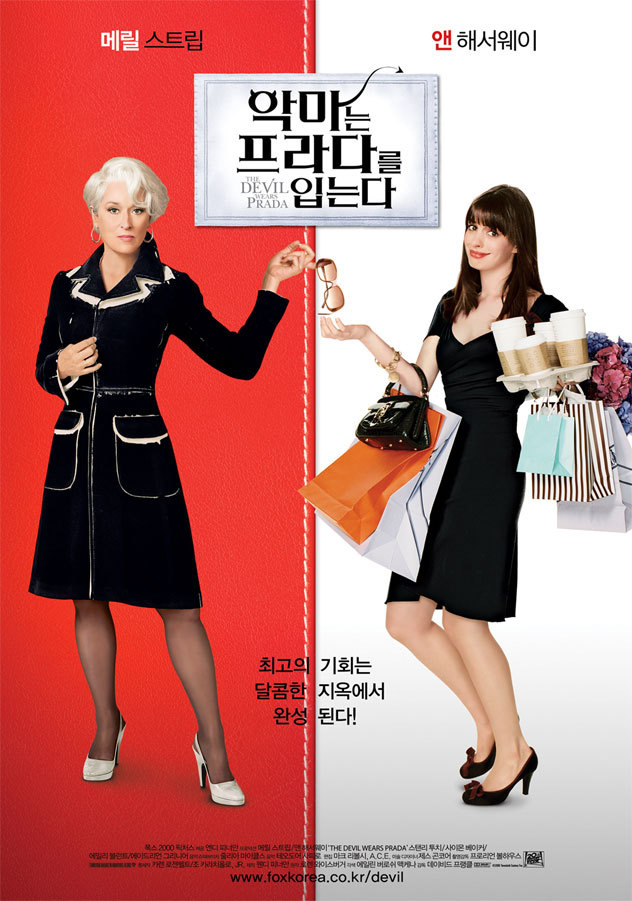
The Devil Wears Prada (2006)
The Devil Wears Prada
8.7
- Director
- David Frankel
- Cast
- Meryl Streep, Anne Hathaway, Stanley Tucci, Emily Blunt, Adrian Grenier
- Info
- Comedy | USA | 109 min | 2006-10-25
I've lost count of how many times I've watched this film. With a running time that isn't long and a pace that's neither slow nor fast, yet the lines and scenes that make you think about so many things have lodged themselves in my mind. Meryl Streep appears with very heavy eye makeup, giving her an image completely different from 'Julie & Julia,' a film I loved, so at first I didn't even realize it was Meryl Streep. But after watching it again and again and again, I no longer pay any attention to such things and instead focus on the message the film delivers. What exactly is the film trying to tell me by showing this kind of direction and these images?
The protagonist, Andy, is an aspiring journalist for a news outlet, but no one is going to hire an aspiring candidate with zero experience on a whim; all she had going for her was her 'academic background' and 'good grades.' Then, with the mindset of applying everywhere, she submits an application to the fashion magazine Runway, gets accepted, and is hired as the assistant to Runway's editor-in-chief, 'Miranda Priestly.' The film progresses with these two protagonists as its axis. Miranda, as the editor-in-chief of 'Runway,' one of the world's leading fashion magazines, lives a life others would envy and is the type who pours herself wholeheartedly into her work. Andy, meanwhile, while showing passion in a field she had never even considered, recalls what she once wanted to do, and the story depicts her looking back on the path she has walked and finding her way back to a life as a journalist.

Andy is a twenty-something woman who is completely clueless about fashion, not even knowing what color cerulean blue is. Yet the setup of her landing the position of assistant to Miranda, the Runway editor-in-chief that so many people coveted, makes it possible to anticipate that she will undergo both internal and external change. Miranda truly seems like the worst editor-in-chief Andy could possibly experience. Miranda assigns Andy dozens of tasks all at once. She has to fetch coffee, swing by four or five shops to pick up the clothes that were requested, and at the same time never be late. Did Andy ever imagine she would be doing this kind of work when she took the assistant job? Being called by a name that isn't even hers, 'Emily,' the position of Miranda's assistant is one you simply cannot hold without working hard all day long. As you can see right away in the photo above, Emily's sense of coordinating outfits is zero, but in that space Nigel takes her to, Andy is reborn.
Honestly, I found the post-transformation Andy truly beautiful. There are several reasons I call her beautiful, but the first thing I want to mention is that she perfectly succeeded in the transformation needed to understand Miranda's profession. This is something of important value both internally and externally. Externally, it means she has properly set foot in the world of 'fashion,' and this is probably most thanks to Nigel's help. The shop Nigel took her to had so many clothes and accessories it was ridiculously enviable. And as for the internal change, it means she steadied her resolve. After Andy is given Miranda's explanation about the economic and social value of the color 'cerulean blue,' Andy truly feels the need to understand this world of fashion. I think the change shown above appeared as a result of that mindset.
Fundamentally, I believe that in order to learn any kind of work, understanding the basic philosophy of that work is essential. And here, in order to understand the philosophy of 'fashion,' there is no answer other than to actually wear it. Of course, looking at clothes can get you there to some extent, but Andy is a woman of New York who has lived a life completely unrelated to fashion. For such a person, the quickest answer is to apply fashion to herself. As shown in the shot above, she is depicted wearing clothes for all four seasons. In the actual film as well, the scene that shows Andy changing outfits in a continuous montage of several dozen-second shots serves as proof that she has perfectly adapted to the 'fashion magazine.'
What about the life of the other character, Miranda? While Andy adapts perfectly, has anything in Miranda's life changed? Her life is no different than before. She is still a Miranda who would readily trample on someone else to climb higher if she had to. But she too had one weakness: the issue of 'family.' On the day Andy went to Miranda's house to drop off the mock-up, she witnessed Miranda being torn apart by her husband. The next day, Miranda, who is flawless at work but didn't want her private life exposed, demands that Andy bring her the unpublished manuscript of the Harry Potter series and declares that if she fails to get it, she'll be fired from the company. (Of course, Andy obtains the mock-up through Christian and through this earns Miranda's recognition of her abilities.) And during the Paris business trip as well, the film shows Miranda struggling because of matters with her husband during the time she's left alone. Watching the weakened figure of a 'mother' who worries about hurting her children by going through a divorce not just once but twice, Andy must have felt sorry for Miranda. Someone who couldn't possibly be more perfect when it comes to her own work is having such difficulty with family issues, so for Andy it's ironic and yet sympathetic, I suppose. For the premise of this film to work, someone has to possess a little bit of a 'human side,' and for Miranda, that part is 'family.'
I think giving Miranda the dimension of 'family' as the kind of vulnerability anyone might have was the screenwriter's intention. If you take away 'family' and 'work' from Miranda, what's left? Hobbies? Would it make her human to show some image of her lacking when collecting figurines or pursuing music as a hobby? No. What she lacks has to be family, for even someone as perfect as her to have a crack. And of course it's only natural that this creates common ground with Andy, who had her own relationship troubles.

The message this film wants to throw out seems to be 'do what you want to do.' Before, I thought it was just about going back to what you originally intended to do, but after watching it many times my thinking changed. I think the scene where Nate, holding views opposed to Andy's, breaks up with her, even if only briefly, became a kind of catalyst that makes Andy recall her past. Of course, the most decisive scene is indeed the one where Miranda and Andy talk inside the car. Through that conversation in the car, the parting of 'Miranda,' who is satisfied living the life others want by rising up over others, and Andy, who is not, means that Andy has resolved to rebuild the principles she once held, and at the same time it means she no longer works as an assistant in the fashion world. And through Nate, who kept his heart steady even as Andy changed, Andy seems to confirm that her choice was not a mistake.
I don't really know what it is that I want to do. Lately, in love, studies, and life in general, I've gradually been finding or settling on things I want to do little by little, but apart from that, I keep weighing whether these are things I could keep doing enjoyably over the long term. When you work, there are jobs that are fun and that you can work hard at, jobs that aren't fun but that you can work hard at, jobs you can only do for fun, and jobs that are neither fun nor easy to work hard at. The ideal condition for a job I'd want to have would be work that is both fun and that I can work hard at. Rather than what I want to do right now, I think I need to find something I can do for a long time.
I want to watch this film again before long. The message the film delivers is meaningful to me, but nothing else is quite as meaningful as Andy's fashion.
Comments 0
No comments yet. Be the first.