
The Probability of Falling in Love in Buenos Aires (2013)
Sidewalls
7.1
- Director
- Gustavo Taretto
- Cast
- Javier Drolas, Pilar Lopez de Ayala, Ines Efron, Rafael Ferro, Adrian Navarro
- Info
- Romance/Melodrama | Argentina, Spain, Germany | 94 min | 2013-09-12
The cell phone invaded the world with the promise that it would always keep us connected.
- Narration in the film -
Bringing it into Korea and changing it into such a long title while translating-how could they translate it as 'The Probability of Falling in Love in Buenos Aires'? Personally, I hate it. It is not that such a title is impossible for this film. But this film is not talking about falling in love in Buenos Aires. The theme of this film is telling the story of 'alienated' people within the urban society of Buenos Aires. Although it does conclude that story with the meeting of the two protagonists.
The film I'll be watching this time is Medianeras, in English sidewalls, which in Korean can roughly be interpreted as the side walls of a building. The Korean-translated title 'Buenos Aires etc.' is a title with truly no relevance at all. I was furious thinking how one could come up with a title this way, but in my opinion, this happened because the film translator hired by the distributor that released it injected their own subjectivity, trying to unfold it as a story about 'romance' instead of approaching the core the film is trying to convey. It is truly a pity.

The film opens by showing various buildings of Buenos Aires. The word 'various' calls to mind a rather pleasant image. But the 'various' spoken of here means that they are not alike and all operate separately. This city is depicted as particularly lacking unity and consistency. For example, in cities like Florence, Venice, and Rome, one sees a 'unity' where the upper parts of the buildings are all covered with red roofs, but Buenos Aires is not like that. The film captures, in several shots, buildings thrown up recklessly, without any plan, without any consistency or unity. This scene captured, symbolically and precisely, more than any film I have seen, the bleakness of the city, the individuality of each, the modern person who does not blend in but operates separately, the solitude within the crowd, and so on. As you can see in the scene above, the buildings have nothing in common. This is truly an aspect of modern society undergoing rapid industrialization, represented by 'haphazard development.' Seoul, at least, has achieved a bit of unification through long years of urban planning. It has become somewhat more alike. But still, don't the high-rises in front of Bukchon and Gyeongbokgung not blend well together? Thinking of that should make it easy to picture.

There was an EBS Docuprime episode on the theme 'Apartment Addiction.' It is one of the documentaries that has stayed most powerfully in my mind among the Docuprime episodes I've seen recently, and I brought over the aerial panorama of 'Paris' that appeared in it. Paris is not dominated by the kind of 'haphazard development' image like Buenos Aires above. The skyline is very similar throughout, and the color combination is calm, varied only by a touch of orange. Above all, the city looks neat at a glance. Even though the buildings only have a certain degree of unity, the bleak feeling is less than in Buenos Aires. Of course, in Paris's case, when urban planners approve the construction of buildings, whether they blend well with surrounding buildings is also subject to review, so this may be why; but it shows a difference far too great from Buenos Aires.

As shown in this scene, the two protagonists (male: Martin, female: Mariana) are like a relationship that passed by, brushing past each other in the city. I think this is what modern society is. Even in the country of South Korea, one of the countless people I brush past while walking through the city center could become a 'someone I know,' like at the end of the film. We just don't know it because we cannot know the future; my life, and the protagonist's life, seem to have been meeting and passing each other within such coincidence. This is exactly the charm of the film. The film captured the solitude within the crowd very precisely. Until now I had never seen a film capture and show loneliness and alienation in this way. They cross paths several times. Once when a dog attempts suicide from a building, the second time when they simply pass at a crosswalk as above. As a result, the two find no commonality and, without any connection, later come to meet through chatting.
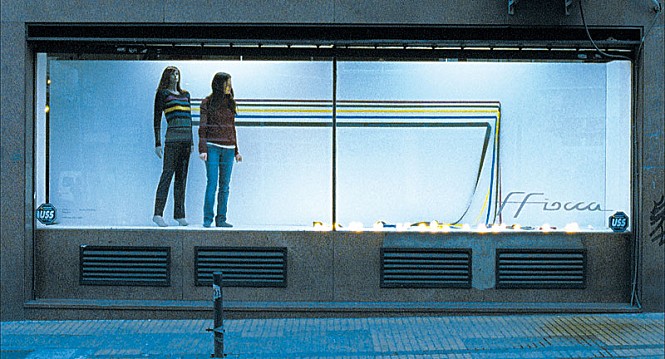
A life that seems to be displayed through a show window, a life that seems to have become a life for being shown to someone-I want to ask people whether they have never thought this. Even in the morning I agonize dozens of times. What clothes should I wear today, what feel should I go for, which bag should I take, and so on. The ironic thing is that this situation in which I want to be seen is actually a life surrounded by 'alienation' and 'solitude.' I could not help but relate to it intensely. Even if it weren't this school, I would have felt the same emotion at other schools, but this school in particular has far too many people I don't know these days. And there is a shortage of people worth talking to, people I can trust and open up to. In such a situation, I come to wonder whether I really need to dress up and attend school. It's not as if I'm living a life for someone else; honestly, I do dress for my own pleasure and to lift my own mood somewhat, but can I really claim that this hasn't been othered at all? A part of my life is surely othered. I think the film wanted to show such a thing through the tool of the 'show window.' Mariana standing inside the show window, and Martin looking at the show window while Mariana steps inside for a moment-that intercuts Mariana looking outward through the gaze of the 'mannequin' and Martin looking back to see whether his own figure isn't like a mannequin. The film showed the underside of the modern person through the very simple yet philosophical tool of the 'show window.'


Medianeras, sidewalls. These walls, which can be interpreted as side walls, are the most useless part of a building. On that wall surface that could be called the title of this film, there were people who lived by making windows in it, as shown above. Martin and Mariana likewise each made windows by boring through the wall, and this can be interpreted as making a passage to the world. Bringing the 'sunlight' one most wants to receive into the most useless wall-what this means is surely an exit for creating a space like light in a world full of 'alienation' and 'solitude,' for truly communicating and connecting with another person.

Actually, I thought readers might not understand what sidewalls look like just from that one part, so I brought another image. Looking at the picture right above, you can hardly see any windows other than the ones they bored. It was originally a wall with no windows-an illegal but tolerated window. Unplanned and not even thought of, but the window bored through subjective choice, beyond mere necessity, becomes in this film a space where the two can look at each other from a distance. As an aside, I thought the director chose the filming locations at exquisite spots. The man lives in the most 'symbolic' part of a men's underwear advertisement, and the woman lived where the arrow points-this can only be something the director planned, not a coincidence. Truly well shot.


Mariana, who one day comes to regard her boyfriend as a total stranger and, after breaking up, searches for her own 'Wally,' and Martin, who lives together with a dog his girlfriend left in his care saying she'd be gone a while-one of them works as a show-window mannequin designer, and the other does work that can be done on a computer. Mariana thinks it would be nice if she could erase the memories in her head all at once, like emptying a computer's recycle bin. Memories with her past boyfriend, and the loneliness of being truly 'alone,' torment her. I too lately sometimes cannot shake a feeling of emptiness when I'm alone in my room, and Mariana likewise feels such emotion dozens of times, struggling with herself for having claustrophobia and being unable to ride elevators. When a man she was interested in asked her to a meal, she regretted being unable to go because the building was too high, and even the decent man she met at the swimming pool ended up never meeting her again after sleeping together once-such disposable human relationships, over which Mariana is very upset, and so she searches for her own 'Wally.' The only Wally she hasn't found, the 'Wally in the city center.'
What connects these two is the most modern yet bleakest thing, 'chatting.' But with a power outage that occurs during the chat, the two, regretting that they will never be able to meet again, go down to a nearby small shop and brush past each other while buying candles that can be lit. They brush past like that, but without knowing that they are the person they just met while chatting-the director sharply shows an aspect of modern society, close in the virtual but so far in reality. And then the next day, Mariana, having seen Martin out with his dog through the window, becomes certain that he is her 'Wally,' rides the elevator all the way down, and they meet, and the film comes to a close.
There were overseas bloggers who analyzed this film while grasping it through feminist elements, but honestly, rather than such an aspect, I thought a great deal about 'alienation' and 'solitude.' Part of it is that my own life lately doesn't seem to be much of a communicating life, and part of it is probably because the intense image at the start of the film didn't fade until the end. I have always perceived the school I attend as a contradictory space, and the reason is this: the fact that the absolute number of people is small so that everyone is someone you know just a few connections away is something I dislike, and the fact that distortion and exaggeration are so severe clashes with the desire to grow close to people. Because once you grow close you come to know almost everything, one-off relationships increase, but if you don't do that, you feel bored, lonely, and alienated.
Having returned to school, I'm now in my fifth year walking this campus, and the fact that there is no sign of improvement at all may be because this was a problem that couldn't be solved from the start, and I approached it too much as something to solve. I think someday it will get a bit better.
Comments 0
No comments yet. Be the first.