
Goodbye, Hazel (2014)
The Fault in Our Stars
9.3
- Director
- Josh Boone
- Cast
- Shailene Woodley, Ansel Elgort, Nat Wolff, Willem Dafoe, Laura Dern
- Info
- Drama | USA | 125 min | 2014-08-13
- I think it's best if only those who've seen the film read this -
As I sit down to write, the rating turns out higher than I'd thought. But a 9 or 10 feels excessive, and since I considered this just a slightly-better-than-average film, I think three and a half is plenty. I'd say the film's subject matter is mostly covered by 'terminal illness,' 'melodrama,' 'high-teen romance,' and 'the Genie' (the Genie can't be left out). Oh, and 'Willem Dafoe,' one of my favorite actors who played Spider-Man's Norman Osborn, also appears here as a very important 'author.' This author is an important channel in that Hazel and Augustus's relationship develops by reading the work of an author named Peter Van Houten together and bonding over that shared empathy. A channel of dialogue between Hazel and Augustus.
1. Terminal Illness
The film's broad context is terminal illness. Hazel is a patient who had thyroid cancer that spread to lung cancer, faced a near-death crisis, and then, on the medical team's suggestion to try an experimental drug, miraculously had her cancer cells decreasing after the drug was administered. A patient whose cancer cells metastasized to the lungs but who is recovering by chance. However, because she has trouble breathing on her own, she carries an oxygen tank and lives always with the help of a respirator. The oxygen tank is loaded into a very small carrier that she pulls around.
Hazel appears as a pessimistic student. In the film's opening, she couldn't be more pessimistic than anyone. But that itself is honesty, and surely the natural attitude of a girl that age facing 'death.' She can't properly do what she wants to do, she used up the wish she asked of the 'Genie' on going to Disneyland just before dying, and she's a lonely person without any proper peers around her. Around her there are only her parents and her primary physician.
Augustus is the man you see on the poster. That is, he later becomes Hazel's 'lover.' Augustus doesn't pursue her to the point of seeming obsessive or pathetic, but the two have something in common in their own way. Namely, that each of them once had a potentially fatal illness. This is a commonality that's not easily shared. Generally, when people share a commonality that's not easily had, they often experience an 'attraction' to the other person because of it. Even I, who am writing this, was drawn to someone over the mere fact of sharing 'the hobby of going to art museums,' so how much more these two? Both want to look strong on the outside but can't, and they're the kind of people who have accepted their own pain and suffering and even resigned themselves to it a little. Of course, I think Augustus staring fixedly at Hazel played a part too. As if showing that no one had ever looked at her for that long, Hazel gazed back at him just the same.
2. Melodrama, High-Teen Romance
If there's no major problem in the film's development, this kind of couple progression usually develops while going through one or two crises. One was when fluid built up in Hazel's lungs and she was rushed to the ICU, because of which Hazel likens herself to a 'grenade' and says she'll one day harm the people around her—and at this point Augustus says that even if his heart is torn apart, he wants to like Hazel. As most men are, in the early days of a relationship he thinks he can overcome anything and repeatedly emphasizes that he has a heart and mentality of steel. He was no different, and carrying a single fear (the 15% chance that even after amputating his leg the cancer cells would spread throughout his body and bring death), the two's relationship becomes a temporary 'friendship.'
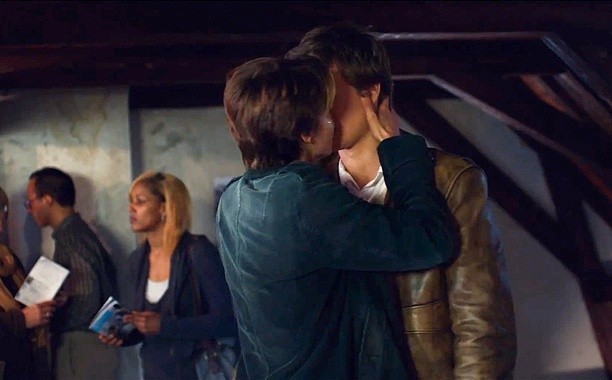
The second crisis is that Peter Van Houten was not the ideal author they had imagined but an alcoholic. Not hearing the answer they wanted, hearing insults toward the sick, Hazel and Augustus fall into 'doubt.' Here the author is a channel that teaches the world's coldness, and at the same time Lidewij (the secretary) becomes the link that develops the two's relationship. It's nothing much, but thanks to Lidewij asking whether they'd like to visit Anne Frank's house, Hazel's will to try doing what she wants could shine. To get to the space where Anne Frank lived in hiding there was no elevator and one had to go up purely 'on foot,' and through the process of personally climbing countless stairs and ladders, Hazel partially thought 'I can do it too' and shows that she's no longer a teenage girl but has become an adult. Up to the scene where, having climbed all the way up, she passionately kisses Augustus and then goes to a hotel to sleep with him, it shows that Hazel is no longer a 'girl.' Through this, it displays its aspect as a coming-of-age film, showing that even a sick person can do what she wants.
If there's a difference with this film, it would be the peculiarity that the protagonist proceeds as if narrating her own past story. The method of showing past events as 'the present' as it proceeds is a part that can give the audience more immersion. A film that tells of a past story while voicing one's feelings yet shows the 'present' is an intervention similar to when I saw The White Ribbon before. However, unlike that time, the narration of Hazel, the narrator and protagonist, is included almost not at all, and by the ending even this narration vanishes entirely. But didn't The White Ribbon fill the film with narration right up to the ending? In that respect, this film is a bit lighter.
To the point that you could call it typical, I've seen this repertoire many times—the protagonist being sick and recovering while the counterpart's illness recurs. The development where one side 'has to die for the ending' was familiar to the point of being common. So in that part, even when I learned that Augustus's illness recurred after the PET scan, I don't think I was all that sad. I suppose I was indifferent, thinking, well, one of them has to die for it to end.
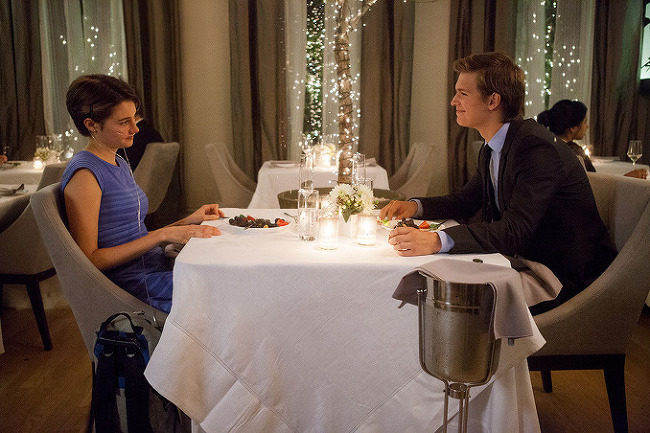
The scene where they dine at a fine restaurant wearing burial clothes prepared in advance in case of death is very impressive. Hazel in an A-line blue dress, Augustus in a suit—leaving the impression that, man or woman, in the end clothes matter—and the scene where they drink champagne is because the situation where what is party wear to others becomes, for them, clothing worn in anticipation of 'death' is a special circumstance unique to them. In that respect, this film was also refreshing.
3. The Genie, Willem Dafoe (Peter Van Houten)
I was so envious of this all-encompassing service called the 'Genie.' An agency that grants one wish you desire, and at that without any cost. (Contextually it seems there's no cost. Even if there were, it wouldn't be a heavily burdensome cost, so whether it was Augustus or Hazel, I suppose they applied.) Before nearly reaching death from lung cancer, Hazel used up her wish on wanting to go to Disneyland, but Augustus hadn't yet used his, and using this wish to meet the author 'Peter Van Houten,' whom Hazel was so curious about, becomes the film's main subject matter.
The one who played Peter Van Houten is none other than Willem Dafoe. In the film he appears as an alcoholic author -> a fine letter-deliverer dressed in a suit. Hazel, who was curious about the story after the ending of the novel this 'Peter' wrote, and Augustus, who, reading Hazel's heart, sent an email to Peter's secretary Lidewij, luckily seize the chance. Of course, this development where things turn out as desired is rather close to a tearjerker and isn't realistic. But I think the film's and novel's development needed this. Otherwise there'd have been no need to talk so much about 'death' and 'pain' from the very start of the novel, and having talked that much, one would have been curious about the author too.
Peter Van Houten doesn't give Hazel and Augustus any kind words. Rather, he's cold and hurls abuse to the point of being interpretable as half-mad. He even plays a song in Swedish. In every case he refuses to talk about the novel's ending. The fact that there's no 'after' to the novel's ending means, in another sense, that the future is still uncertain for the protagonist and Augustus too. As you'll feel watching the film, the novel's protagonist and Hazel resemble each other. Hazel even seeks out and wears the matching T-shirt to resemble her. This is Hazel's action of believing there's a 'future,' of 'trying to live,' and wanting to believe in it. But Peter is saying that this struggle is useless. Ironically, since she became an 'adult' amid such despair, the showing of a 'universality'—gaining greater realization and maturing at the hardest time—is, I think, a consideration by both the director and the original novelist.
I didn't feel anything particular from the part where Peter comes to the funeral and hands Hazel a letter. There was nothing beyond the point that Augustus had really loved Hazel. And it was fine that Peter had 'thoughts' of his own in his own way. After all, he's the very one who cracked open the eggshell of Hazel and Augustus.
4. A Film That Induces Tears, and 'Living On'
The film 'Wish (Hope),' which I saw before while on leave from the army after donating blood, expressed well the 'part one should focus on' in a film as I see it, so it wasn't strange at all that it made me cry. Rather, I thought, 'Ah yes, this is what matters—what's needed is to embrace and soothe the victim's heart.' This film falls a bit short in that respect, but there was one thing that was fine. It's the point that 'a funeral is for the living.' Hazel's mother says this. The words 'when you die my heart will break and it'll be hard, but still, we just live on' are all in the same vein. Hazel folding the eulogy paper she'd prepared and, for Augustus's parents, saying something kinder—she may keep to herself the story she held about this person, but saying words that can lead to a better ending—in this way, even though Augustus dies, in the end we live on. It's hard and our hearts break, but still, we live on.
5. Other things..
In the film's title 'the fault in our stars,' the fault is the terminal illness, and our stars refers to the protagonists themselves. Calling teenagers 'stars,' it seemed to show fairly well, in its own way, the changes in life they undergo because of the single flaw (terminal illness) they carry. It didn't just show the 'flaw,' and by showing that even they, who bear a flaw, are similar to other people, this film was in the same vein as films about protagonists with terminal illness or disabilities.
Before watching the film with my girlfriend, the thing I said as we sat down was 'I really just watch the movie,' and my girlfriend says she fully realized the truth of that. She said it was amazing how I watch the movie as if I were some critic. I really am the type to just watch the movie, but having to go tell a staff member because the sound wasn't coming out well partway through was a real nuisance..
And, in preparation for the trip I'm heading out on next week, I wonder if I should write a will or something, but I just plan to have a good trip. I'll go and come back without any worries. And, I should think about whether I'm really more of an adult than these protagonists. This thought will be one of the things I plan to neatly fold away on this trip.
Comments 0
No comments yet. Be the first.