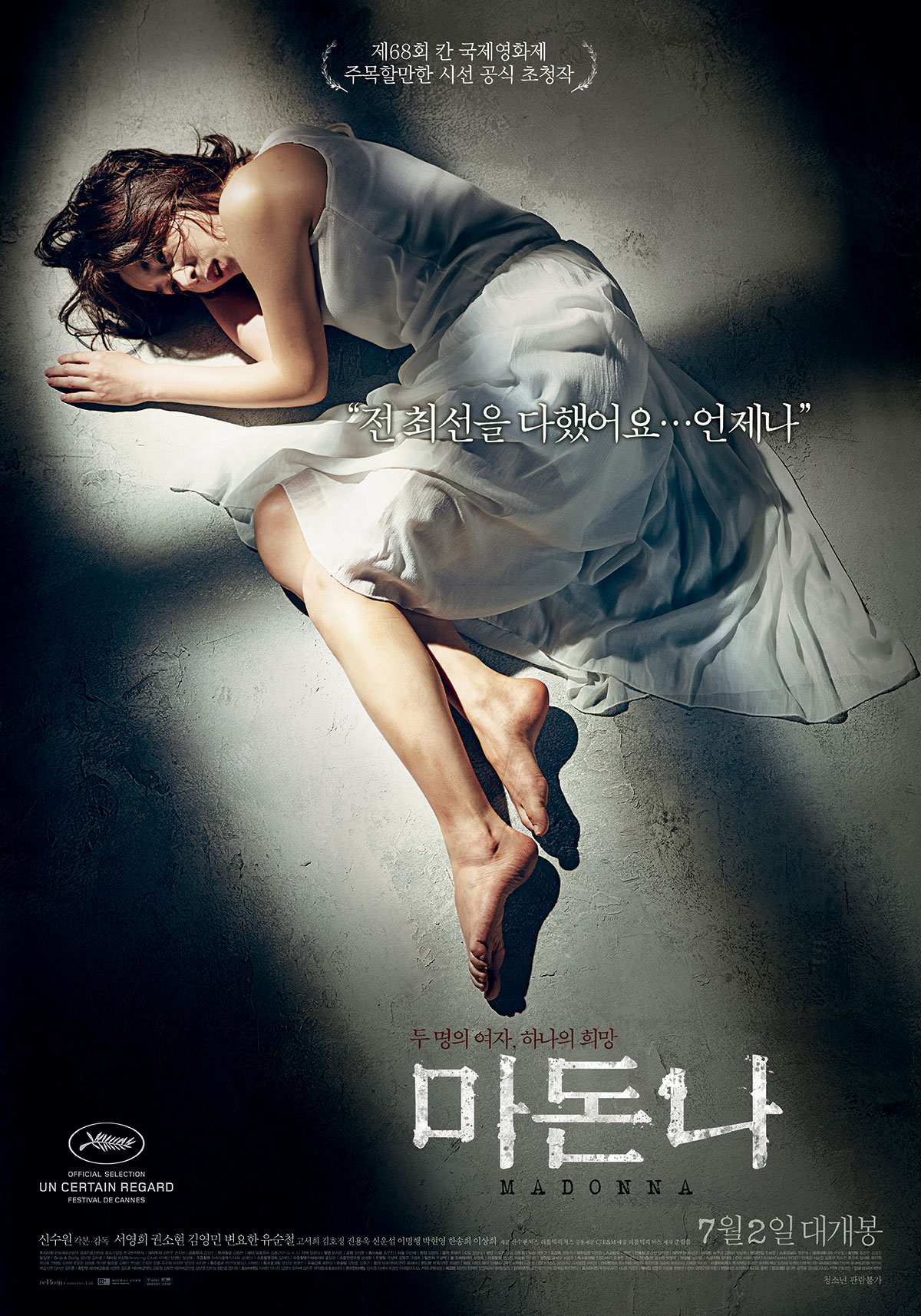
Madonna (2015)
Madonna
8.4
- Director
- Shin Su-won
- Cast
- Seo Young-hee, Kwon So-hyun, Kim Young-min, Byun Yo-han, Go Seo-hee
- Info
- | South Korea | 121 min | 2015-07-02
The story of 'Mina,' who wanted to be a 'Madonna' to everyone but could not become a Madonna to anyone.
-Before we begin-
This piece may contain some spoilers about the film. But I think it is fine to read this and then watch the movie. I believe you can watch it while reflecting on a wider range of social issues. However, if you would rather not know in advance, it might be wiser to read this as a piece for organizing your thoughts after you have already seen the film.
----
When a film I'm watching sharply cuts into and digs at the 'dark side' of society, I often feel a strange ache in my chest. The reason, more than anything, is that it revives my guilt and self-reproach over having known that reality yet not 'facing' it head-on, along with the critical consciousness toward society that lies beneath. And yet I feel this way when I'm confronted with countless facts that I cannot change through my own actions right now. That's why I think we have to watch films like this one, films that 'make the heart uncomfortable.' But because it's a film that leaves the heart uneasy for a while afterward, you can't carry away good memories of it. The film I want to talk about today, 'Madonna,' is exactly that kind of film. Madonna, the Madonna I know, is the 'Madonna' as a sex symbol, but here she is called 'Madonna' in a deeply paradoxical sense. The keyword I'll use to discuss this film today is 'theme.'
Since the story unfolds through the thorough focal narration of a nurse named 'Hye-rim,' in novelistic terms this film corresponds to a 'first-person observer point of view,' but because it is closer to a frame structure, within the framed story 'Mina' is the protagonist, and the school friend, the insurance company colleague, and the cosmetics company colleague who unravel Mina's story each appear as narrators. These people all share the common trait of being 'women.' In this film, the essential perpetrator cannot be pinned down as any one person. Rather, society itself is simply the perpetrator. The perpetrators within that society are the people placed in positions of 'power': at school it is the schoolmates, at the insurance company it is the insurance company supervisor, and at the cosmetics company it is the son of the cosmetics company president. They commit violence such as bullying, impregnation, and rape. Because the men commit rape and violence, one might think of it as somewhat of a male-bashing film, but rather than seeing it that way, I think 'Mina' was set as the protagonist because what she experiences is something that actually happens in society, something that occurs quite openly and commonly, the kind of thing a woman who 'was never properly loved' might go through.
1. Theme
There were quite a number of issues the film deals with. Organ trafficking (donation), the extension of life, giving back to society, how the rich live their lives, the lives of VIPs, the dominant-subordinate relationships of working society, the abortion issue, collective bullying at school, how a child from a poor home gets by—so many social problems were intertwined that it would be impossible to unfold the film through just 'one' theme. And it's worth remembering that this very fact of being so heavily 'intertwined' is what actually makes the film realistic.
1) The wealthy's methods of extending life, and organ trafficking
Honestly, I agonized a lot over which topic to start with. I really debated whether to begin from the part where a baby's cry comes from the gray, watery scene at the film's opening, or whether to start from the job of 'nursing assistant.' In the end, I figured it would be better to discuss the most easily 'grasped' element first, the 'VIP ward,' so I brought this up.
When we divide it into setting and character, the one that appears first is the setting. The 'VIP ward' shown in the film displays the hospital's 'owner' and the 'patients' in the VIP ward, and even to me, watching a hospital room that costs 3 million won a day left my jaw on the floor. There's an 'external' dimension that tells you what kind of place a VIP ward is: the interior almost indistinguishable from a private home, the carpet in the hallway, of course, and on top of that the part leader's advice that even though she's a nurse she must wear 'makeup,' the situation where you can't move around without a key and a passcode, the existence of an individual nurse assigned to each patient, and so on. Three people in total appear using this place. The first is the owner of this hospital. In a state where he can only open his eyes and move his middle finger ever so slightly, he is having his life forcibly prolonged by his son for the reason that 10 billion won comes in under his name each month. The wealthy man who must keep on living a life he does not want to live through repeated heart transplants is precisely the owner of the hospital. The second is a 'corrupt official' who committed crimes but, diagnosed as being in poor health, stays at the hospital; he appears in only one scene. It's a scene where, because he has so many things attached to his left hand, he asks 'Hye-rim' to change his clothes, and in this scene Hye-rim feels skepticism toward the VIP ward for the first time. The third is 'Madonna,' who drives the film's narrative. 'Madonna' is a nickname, and her real name is 'Mina'; this 'Mina' appears as a woman who was 'found' on the street to supply a 'heart' to the hospital's owner.
The hospital's owner cannot even die because of his son and is having his life prolonged, and watching this, 'Hye-rim,' who drives the narrative, says she would like to live like this for even a single day. Like me, a great many people find it hard to be hospitalized in a room that costs 3 million won a day. Well, it's not that she'd really want to do it for just one day; it's that being in a hospital that way is something she can't even conceive of in the first place. To such a Hye-rim, the life-extension of the hospital owner 'Cheol-o' is something she envies precisely because it's so absurd. To make this life-extension possible, the cliché of 'organ trafficking' appears, and while organ trafficking is surely happening covertly even now, I never thought a film would bring up organ transplantation so 'overtly' like this. The son, who orders that another heart be found quickly when the father's body shows rejection of the transplanted heart, appears to worry about his father's death, but on the other hand he is a being who worries because he knows that without the money coming in under his father's name, he himself is nothing. The son shouts at Hye-rim that there are also people who don't want to live, looking at 'Mina,' but paradoxically one can see that his own father is the one to whom this applies. In the figure of 'Cheol-o,' whose life is being forcibly prolonged, there is more agony and suffering than happiness.
2) The dominant-subordinate relationship
One of the biggest topics in society these days is precisely the 'dominant-subordinate relationship' (gap-eul relationship). This dominant-subordinate relationship is spread throughout society. It's usually compressed into the relationship between 'employer' and 'worker,' and since it's a characteristic of Korean society that basic consideration for those in the subordinate position is poorly established, the film relentlessly exposes this trait.
Even in the relationship in the VIP ward where the 'nurse' treats the 'nursing assistant,' the relationship is constructed with the nurse as the 'dominant' and the nursing assistant as the 'subordinate,' and Sang-woo, the son of the hospital owner Cheol-o, acts as the 'dominant' toward the doctors of the hospital he runs, showing a relationship where the doctor becomes the 'subordinate.' Also, 'Mina,' who always did her utmost in every moment, was always the 'subordinate' at the insurance company where she worked, and appears as the 'subordinate' at the cosmetics company too. What struck me deeply here was that, while films usually depict characters or settings in a very simple state, this film portrayed in great detail the very life that is complexly interconnected. It very naturally depicted the fact that, for Mina, who grew up without parents and lived with her grandmother, no friends existed, and that although she always wanted to be loved, there was no one to love her.
I felt the director precisely captured the countless meanings contained in her single line, 'I always did my best.' Mina's resonance—that she always did her best, yet no one did anything for her, gave anything back to her, or brought her any joy—stirred deep empathy in me as I watched the film. Mina does the very best she can. Told to dye her hair, she dyed it in whatever way she could in her impoverished situation; she did the work just as the insurance company manager ordered; and even at the cosmetics company, having been told that measures would be taken, she did not report it, but the measures were never carried out.
Another striking dominant-subordinate relationship was the one between the hospital's young doctor and 'Sang-woo,' the son of the hospital owner Cheol-o. As I briefly mentioned earlier, the 'young doctor' confirms that Mina's consciousness has returned and reports it, but at the 'party' held that night, the young doctor suffers humiliating treatment from Sang-woo. (I won't mention this part. The humiliating treatment was a scene you'd surely empathize with a hundred times over if you saw it for yourself.) It shows just how enormous the existence of the 'dominant' is to a young doctor who tries to handle matters truthfully and work according to his 'convictions.'
3) Hye-rim and Mina, Madonna, and the child
In the film's intro, the cry of a 'baby' is heard from within the bag that 'Hye-rim' throws away at the gray riverside, and this scene means that Hye-rim is abandoning her 'child.' One could sense that Hye-rim made such a choice because she was placed in an environment where raising a 'child' was difficult, but ironically, as she investigates the past of 'Mina,' who tried to raise her child despite being in an even more 'difficult' environment, Hye-rim comes to reflect on herself. She realizes the fact that the woman called 'Madonna,' even though she had not wanted the child, struggled to live in order to raise the child as best she could.
The 'tug at the heart' I felt in the scene where she says that, although no one ever gave me love, the 'child' taught me what love is—that feeling was truly hard to put into words. I think it's probably the scene where 'Hye-rim,' recalling her own past once more and reflecting, resolves that she absolutely must save the 'child.' This is because her own experience of an unavoidable pregnancy appeared in stark contrast. Hye-rim, who abandoned her child in order to live for herself, and Mina, who, looking at her child, thought she should go on living more. The director probably, by showing these two women's figures in contrast, did not so much make us choose what we ought to take, but rather made us ponder what would be an acceptable way to live in unavoidable circumstances we face, and how we should have helped them.
2. Reality
The issue of unwed mothers, even if it's not right around me at the moment, is something that commonly happens. Countless men cast aside the woman alone, leaving behind a child in which 'their own sperm' was involved. In the film, Mina is precisely the one who becomes this 'unwed mother.' But there is no such thing as a wealthy unwed mother. If the woman's family had money, they would have had her married, and she would not have become a mother while 'unwed.' When runaway youths, or youths with no home or in difficult family circumstances, become 'mothers,' most of them end up as unwed mothers.
Sexual harassment and sexual violence at companies are still things that happen. The director drew out, from the most easily accessible 'company,' a problem that occurs everywhere without exception—in the military, in universities, in companies. And he also did a good job of pointing out that such sexual harassment usually occurs in situations based on 'power relations.' Although they say society has changed a lot and the atmosphere has become one where people can speak up more about such 'harm,' countless women are still placed in a position where they cannot speak about this problem.
The issue of society's support for children living with a grandmother or grandfather is the part that is handled most poorly in our country. It's not as if such families cannot be relieved under a national tax structure that collects little and spends little. But taxes are still spent in the wrong places, and no solution has been prepared for how to support single-parent families or poor grandparent-headed families. The director meticulously captured the hereditary transmission of status.
3. In closing
The problems I discussed above were explained through extreme 'compression,' but in the film these scenes unfold smoothly, as if drawing a synopsis. Without the slightest disarray, to a degree that's truly astonishing, Mina is a victim from beginning to end, to the point that it made me ponder whether she really had any 'reason to live.' That's why, all the more, when it says 'there are also people who don't want to live,' this phrase sounded quite complex. It's probably because it stirred the sorrow of asking why a phrase that applies to 'Cheol-o,' a wealthy man who wants to die, must also apply to 'Mina.'
At the very end of the film, in the situation where Hye-rim is heading somewhere on a bus, the 'photo at the photo studio' that she sees was a 'pregnancy celebration' photo that Mina had taken wearing a wedding dress. Just from this photo alone, it seems 'Mina' did have a reason to live.
Comments 0
No comments yet. Be the first.