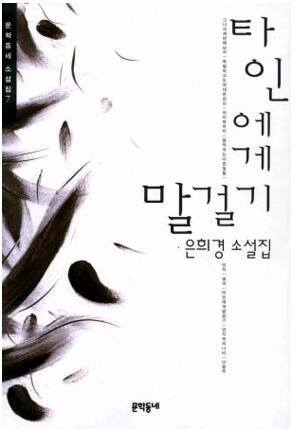
1.
This was my first time with Eun Hee-kyung's fiction. Since this author's work was on the 2014 teacher certification exam, I'd been thinking I should read it at least once, so I chose this author after Kim So-jin. Of course I wanted to read 'A Special and Great Lover,' which appeared on the teacher exam, and I was curious about the other short stories including that work too. Well, in a situation where I'm breezing through short stories like these days, a full-length novel isn't bad either, but the more I think about it, the more I feel full-length novels are hard to put on an exam. The part you put on an exam would be where the thematic consciousness is revealed, and to choose from a full-length novel you'd try to find a work where the thematic consciousness is revealed throughout the 'whole novel.' Otherwise, being 'full-length,' the content inevitably becomes long to depict the plausibility of the part revealing the thematic consciousness. Then you reach the conclusion that, unless it's something like 'Three Generations' telling of a consistent conflict or a social-realist novel like 'Cheonbyeon Punggyeong,' the thematic consciousness of a full-length novel is spread out and thus hard to find! So I figure reading short stories is much better. For that reason I'm reading various short stories, and this time too it's short stories.
'A Special and Great Lover' was a work that appeared on the 2014 teacher exam. Honestly, before that I had no interest in this author. I'd only heard the name a few times, but actually reading the work, I thought it was really interesting. I strongly felt it was the work I'd been searching for all this time. The reason it's a 'work I'd been searching for' is this. Including the books I've read in succession recently, most Korean literature is full of novels where 'male psychology' is the main thing. Perhaps because there are far more male authors, it's all the more so. That's not to say there were no female authors active during the Japanese colonial era. There were female authors then too. But the 'psychological description' I want had more psychological descriptions that fit the historical situation of that time, so it wasn't what I now empathize with and need. As a result, I wanted to read a work that well reveals the 'psychology of modern women.' And this story collection lived up to that expectation.
2.
There were 9 works in total. The book was a little over about 300 pages, and since it had been printed a long time ago (the 1999 print edition), the paper was a slightly 'reddish' book. That acid paper? I think I vaguely heard about it; this book carried a feeling similar to those 'red paper' books still at my hometown house in Gwangju. When you read it while walking, 'sunlight' hits the paper, and once the sunlight disappears, it was a book you couldn't look at the paper of, as if you'd gone blind. I was so absorbed in this book that I felt like reading it while walking down the street. I'll cut the digression here and introduce the works.
1) Her Third Man: I think the image of 'fog' always carries 'illusion.' I think the 'fog' revealed in this work meant something beyond simply illusion. In the space of the 'temple' visible beyond the 'fog,' the protagonist 'I' seems to discover the truth about her own past. Is calling it 'discovery' too 'investigative'? Hmm.. so, while gaining insight into her own past and watching the people during her stay at the temple, she approaches the 'truth.' It's a structure where she gains awareness of her present situation in the space beyond the 'fog,' and then returns to 'reality.' In Record of a Journey to Mujin too, the device of 'fog' was used in this way. The 'fog' truly is an attractive 'device.'
2) A Special and Great Lover: This is the work that recently appeared on the teacher certification exam. Actually I borrowed this book because I wanted to read this work. It's about 30 pages, but reading this work, all sorts of thoughts came to me. I wondered whether I'd ever seen a work that depicted the psychology from 'just before breaking up~breaking up' this well. 'Lover'—for everyone, 'one's own lover' is special and great. The first relationship might not start that way, but after dating for a while, it seems you come to wish for a 'special and great lover.' The more you see people's commonalities and get the feeling that this person or that person are all pretty similar, the more, I think, you search for a 'special and great' person. More than such things, what I was more curious about was how she could pull off such meticulous 'psychological description,' and this psychological description was so marvelous that, honestly, I was just amazed as I read.
There was a sentence that stayed with me, so I copy it down.
The woman's analysis and the man's sentiment. Which side is luckier, and whose thinking is closer to the truth? That is both an unanswerable question and one there's no need to know. Do you think your life can change just because you know it?
Actually, this doesn't need to be judged. Few things are as exhausting and meaningless as viewing everything in terms of right and wrong, near to or far from the truth, lucky or unlucky. Both have value and both are simply meaningful. For an individual, whether it's 'sentiment' or 'analysis,' so what; it's enough if you can affirm that one memory was created from it. (Of course it's not easy. Easier said than done.)
3) Yeonmi and Yumi: Seeing 'Nyukaseul,' I wondered if it was 'Newcastle,' and it really was 'Newcastle.' I was glad England came up. (It reminded me of my volunteer days..) That's not what I meant to talk about, hmm; in this work, the 'older sister's' story really made me think a lot. The people who said similar things to me came to mind, and I wondered whether they had wanted to do things that were impossible from the start. Or maybe not—maybe they were things that were possible but they gave up early. My own past came to mind too. I was like that too; in the situation where I was like that, the other person was like that too—what a coincidence this is. Memories just remain as memories.
4) Things Different from What You'd Guess: For a moment after reading it, the thought briefly crossed my mind, whether I should have died on the way to Korea... But unlike before, this thought won't weigh on my mind for days. It disappears in 5 minutes. I don't want to talk about the content. The content is gloomy but the mood wasn't gloomy. So I don't know how to talk about it.
5) The Poor Wife: Life after marriage looked really difficult. Hoping it shouldn't turn out like this, I stored the story in another cabinet labeled 'a bad example of married life.' The method of the husband peeking into diary-style writing reminded me, hmm, of 'The Fool and the Idiot.'
6) The Key: Hmm, anyone is a being 'meaningful to someone,' and I got the feeling that the protagonist's childhood memories created the situation of the protagonist's 'adult years.' Who am I meaningful to now, and which people around me are meaningful people to me?
7) Talking to Strangers: 'Strangers'—has there ever been an era where the definition of the word 'stranger' is as complicated yet simple as in modern society? We no longer live within a community. Before, I'd still occasionally greet the elders I met in the apartment elevator, but at my studio apartment there's none of that. It's a shame. In an era where 'neighbors' and 'community' have disappeared, 'strangers' are both everyday and not everyday. The present era is one where you're a stranger because you don't know someone, but a stranger even if you do know them. 'I' is a person who endlessly wishes to be a 'stranger,' and 'she' is a person who searches for a 'meaningful person' rather than a stranger. But a stranger is still just a stranger.
8) A Butterfly in the Dust: It's a 'title' whose images don't quite match. (The image of 'butterfly' and the image of 'dust,' that is.) After reading the whole work and looking at the title again, I think the author may have actually intended to hint at the content in the very phrase that a 'butterfly' is in the dust. It's a first-person-narrator novel by the author, which was rare (in this book). But actually the images that appear seem to be more about others' stories than about 'I.' Hmm, is a man just a man? I don't know. What on earth is the difference between obsessing and not obsessing? Or is it actually a story about 'women's liberation'? It's a novel I can't quite understand. I don't know what it was trying to say.
9) Duet: It's a duet of 'Jeong-sun' and 'In-hye.' To be precise, a 'mother-daughter relationship.' After reading this work I texted my mother. Asking whether she'd regretted teaching me to grow up 'morally.'
3.
If I had to summarize the characteristics of Eun Hee-kyung's fiction in a word, it would be 'meticulous psychological description.' I think this is the first 'modern work' I've seen with psychological description done this well. I felt it was a bit closer to my era than Kim Seung-ok's novels. So perhaps that's why it was interesting, relatable, and brought many things to mind.. It was truly a worthwhile novel to read. Next is the collection containing Oh Sang-won's 'Reprieve.'
P.S. Hmm, to be precise it took a little over 50 minutes, so one piece of writing was completed. I really have grown more skilled at writing lightly and quickly. It reminds me of what I told someone yesterday, that 'language skills' can be mastered through much practice. Writing improves only by writing, and reading improves only by reading repeatedly. The more I read, the more I understand why 'short stories' are exam-worthy, and I also think that among 'full-length novels,' the ones likely to appear are predetermined. The tension of a short story is too hard to maintain in a 'full-length novel.' So if a full-length novel does appear, it's a truly 'solid full-length novel.' But short stories are much easier to put on an exam because you have to meticulously construct the part where the thematic consciousness is revealed. And since they're read quickly, they can only be easier.
Comments 0
No comments yet. Be the first.