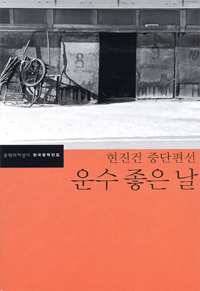
1. If one were to summarize early-1920s Korean literature, one must mention Lee Gwang-su, Kim Dong-in, Yeom Sang-seop, Hyun Jin-geon, and Na Do-hyang. Having already mentioned Lee Gwang-su's 'The Heartless,' and having mentioned Yeom Sang-seop and Kim Dong-in as well, I couldn't leave out Hyun Jin-geon. Personally, it's also because I'm expecting 1920s literature to appear on the 2017 secondary-school teacher certification exam, and because Hyun Jin-geon is called the writer who most successfully established the 'short story' in Korean literature. In particular, his short story 'A Lucky Day' is famous enough that you could grab anyone passing by on the street and they'd know it. Indeed, even a friend with no interest in Korean literature knew 'A Lucky Day.' It's because the 'irony' that comes from the title 'A Lucky Day'—and from the situation, where Kim Cheom-ji earns a lot of money while his wife was, as he suspects, already dead—faithfully demonstrates a simple but truly important 'irony.'
This time I intend to write the piece including a scholarly study on Hyun Jin-geon as well. Writing it separately would scatter the content of the works and end up making me write two pieces for no reason, so rather than that, I think it's better to write one piece of good quality.
Hyun Jin-geon's family was a 'family of interpreters,' and the characteristics of this 'interpreter family' are clearly revealed in the late Joseon period. The reason for this is that, being an 'interpreter family' at the time, they were very sensitive to the currents of the era, and there was the success of the 'father's generation' who rode those currents well. Of course, the 'father's generation,' including Hyun Jin-geon's first cousins once removed, rode the currents of the era in various ways. Some resisted by working against Japan, some collaborated with Japan, and some worked at foreign legations—Hyun Jin-geon was born into such a 'rising family.'
The points to know about Hyun Jin-geon's life can, I think, be condensed into: an 'early marriage' to a woman who was not a 'New Woman,' a study-abroad in Japan that ended rather quickly, and his life at a newspaper. The conflict that appears in his relationship with his wife shows up in 'A Poor Wife,' 'A Society That Pushes Drink,' and 'The Degenerate.' The problem of the Japan study-abroad could be confirmed in 'The Degenerate,' and the reason I bothered to mention his 'newspaper life' is that I wondered whether his reporter career had some influence on the emergence of his 'observer's gaze.' Because what we can confirm just by reading is that 'A Poor Wife' and 'A Lucky Day' are too different, and that this gaze continues into 'Hometown,' and so on.
The researcher Yang Jin-o wrote that the death of his older brother 'Hyun Jeong-geon' during the independence movement probably had a considerable influence, but since there's no easy way to know whether that's really so, I won't discuss this part.
2. Because they were all works centered on really, really short stories, there are quite a lot of them. It does feel a little more difficult than other days, but there's no other way. The work from here that appeared on the exam—'The Grandmother's Death' comes to mind right away—but besides that, we need to know at least 'A Poor Wife,' 'A Society That Pushes Drink,' 'Madam B and the Love Letters,' 'A Lucky Day,' 'The Degenerate,' and 'Hometown.' The remaining works are really important too, but these works mentioned above serve as a good framework for understanding Hyun Jin-geon. I'll summarize each one in a few sentences. Once again I'll note: for most of my pieces, including the posts related to the Korean Literature Collection, I recommend reading the works first before coming.
1) Sacrificial Flower : This is the debut work. But it's quite immature. The reason such an 'immature work' came out is that, at the time, Hyun Jin-geon's first cousin once removed held a position at a literary coterie magazine, and the records show that Hyun Jin-geon asked for this work to be published and it was. But because it was an excessively immature work, it received harsh reviews from the critics of the time. It's composed of the story of a 'sister' and the 'younger brother' who has that sister, but honestly, even I couldn't quite grasp what it was trying to express. If I had to connect it to something, I'd say it was a work that tried to express the modern protagonist who experiences the 'love' Kim Dong-in spoke of.
2) A Poor Wife : This is a work he polished over the year following Sacrificial Flower. It's a considerably more refined work than Sacrificial Flower, and considering the time of its publication, its level of completion can be rated even more highly. The early 1920s was the point when proper 'modern Korean fiction' began to appear. Viewing it as a period when it hadn't 'properly' appeared yet but was slowly emerging, I think one can understand whether this 'A Poor Wife' is an important work. The relationship between husband and wife that appears here also depicts the wife as a somewhat 'ignorant person.'
3) A Society That Pushes Drink : The researcher interpreted this work as an 'autobiographical novel.' The reason for interpreting this work as autobiographical is that it set as protagonists an 'intellectual' husband and a wife who cannot understand her 'intellectual' husband, and this matched Hyun Jin-geon's married life somewhat. The reason we need to understand Hyun Jin-geon's married life here is that in many writers' lives, novels with content similar to those writers' married lives appear. The situation of pushing drink on an intellectual—in other words, on an 'intelligentsia'—is essentially no different from the situation of pushing drink on the writer himself.
4) Violation : It should probably be read as content about K violating Jeong-suk, but seeing that it's marked 'incomplete,' it seems the work isn't properly finished. It can be seen as one of the novels in which Hyun Jin-geon depicted 'love.'
5) Piano : It's a novel about two and a half book pages long, and satire appeared. It's a short story that left me admiring how satire can emerge in just two and a half pages. The 'piano' is ultimately a device meant to satirically reveal the 'extravagant behavior' of the wealthy people of that era.
6) The Grandmother's Death : This is a 'satirical novel' written by Hyun Jin-geon. It's really short, but it's a work where the writer's descriptive power, precisely capturing the characters' behavior, stands out. In that it captures the actions of various people from a first-person point of view while the narrator's own actions also appear as objects of satire, it shows a structure slightly different from 'My Foolish Uncle.' In that it begins with 'the grandmother's critical condition' and, after the 'grandmother' recovers and everyone returns home, she meets her death right after they return, this work is a well-constructed piece.
7) At the Post Office : It's a work featuring a protagonist who receives a 'manuscript fee,' and it gave the feeling of being not much different from the situation of the writer receiving a manuscript fee. The scene where his heart stirs when he's asked whether he is 'the person himself' is a part that very effectively reveals the psychological suffering of a person living under colonial rule.
8) Blind Man's Bluff : It's about Sang-chun and Hak-su going to a concert, and this too is a short story. It's a work that captures the social atmosphere in which the idea of free love was beginning to appear, and it shows a narrative setup that contrasts Hak-su, who has a severe complex about his appearance, with Sang-chun, who doesn't, reversing each other's situations.
9) The Longed-for Glaring Eyes : I understood it as a work with an inherent critical gaze toward the female protagonist. The female protagonist here is a 'gisaeng,' and it's a novel that makes you feel sympathetic toward 'that man.'
10) A Lucky Day : When we think of 'irony,' the first work we examine is precisely this 'A Lucky Day.' Through the title it realizes 'irony through language,' and through the internal situation of the work it realizes 'situational irony.' It's significant in that it expresses, in a truly astonishing way, that Kim Cheom-ji earning good money is a good thing but is in fact not a good thing. However, in that it also shows the common man as seen through the eyes of an 'intellectual,' it's interpreted as both Hyun Jin-geon's masterpiece and a work that reveals his limitations. This is because Hyun Jin-geon created this work not as someone who was actually 'poor,' but through the eyes of an 'observer.' In that it depicted the conditions of the era very realistically, it's also viewed as a representative work of realism.
11) Foot : It's a work whose main content is a scene revealing the tyranny of a policeman over a 'foot-gear peddler.' The subject matter here is the incident that occurs as a policeman tries to absurdly slash the price of the goods of the 'peddler,' who appears as a common person. This too is a work of realist fiction.
12) Fire : The content of this novel is that 'Sun-i' sets a 'fire' as a way to relieve the suffering she received within the household. Suffering caused by her husband and suffering caused by her parents-in-law are revealed. It's a work that brings to mind the similar novel 'Samryong the Mute.'
13) Madam B and the Love Letters : It's content that satirizes Madam B—that is, the 'Madam B' of a girls' school—by showing her double-faced behavior: cracking down on the students' love letters while she herself uses those love letters to pleasure herself.
14) The Director of the Private Mental Hospital : It's about W, who becomes the director of a private mental hospital, going mad himself instead. But it's not simply 'content about going mad'; in that it suggests that economic poverty brings about mental poverty, it's a work where you can examine the 'destitution' of the era's conditions. This work, too, makes the reader feel sympathy for the protagonist W.
15) Hometown : This work is unforgettable. Here the narrator is an 'observer,' so the main content is the story of the 'man heading up to the city,' the object of narration, because the wretched story of the 'man heading up to the city' is a life that represents the lives of the common people under the colonial reality of the time. When that truly poor man returned to his hometown, the hometown was in a state of near-total destruction, and he met a woman with whom marriage talks had once been exchanged, but she too lived a destroyed life, and through this it depicts the miserable colonial reality. The narrator still has a slightly 'intellectual' side, a bit distant from such people, but there's no room for objection to the fact that this work captured the reality of the Japanese colonial period very well.
16) Sympathy : It reveals the figure of a common man making his living through a rickshaw and the figure of a person who appears to be an 'intellectual' involved in an unwanted accident. Unluckily, the rickshaw was broken in the accident, but the shame and sorry feeling that 'I' feels about this are blended together, and it's a work that depicts the life of the lower class represented by the rickshaw puller.
17) Chastity and Medicine Cost : It depicts a doctor who mocks the figure of 'that woman' who throws away things like chastity to cure her husband's illness, but in reality the 'doctor's' behavior becomes the object of criticism. In a situation where there's no other means to pay for the medicine, the woman's sharing a bed isn't depicted very negatively. Rather, it makes you question the situation where she could do nothing else, and it's a work that makes you compare the living conditions of the common people of the time with the values of the somewhat better-off people represented by the 'doctor.'
18) Newspaper and Iron Bars : It's a novel written from the viewpoint of 'I' about an 'old man' who came to the holding cell for stealing 'newspaper.' 'I' am also one of the people in the holding cell, and at first the group's sympathy for the old man increases, but when it's revealed that the old man's words and deeds were a lie, people withdraw their sympathetic gaze toward the old man all at once and instead come to view his actions critically—yet it's a work that makes you keep thinking about the 'old man's' situation, in which he could do nothing else. The 'old man' here can again be seen as the common class under the Japanese colonial period of the time.
19) The Clumsy Thief : It's a work that reveals the economic destitution of the common people. Even just looking up to this work, Hyun Jin-geon depicted 'the poverty of the common people' very consistently. Because the way of solving poverty isn't a socially permissible act, on the surface it seems to become the object of criticism, but in fact it's a work that criticizes the 'situation' where one could do nothing else.
20) The Liquidation of Love : It's content where the lover of Kim Hyeong-sik, who is in 'prison,' comes to visit and confesses that she has begun seeing another lover. Yang Jin-o said this work probably took as its material the prison life of Hyun Jin-geon's older brother 'Hyun Jeong-geon,' but in my view this is perhaps too much of an approach connecting it to the writer's life. In any case, with the woman liquidating the 'romance,' Kim Hyeong-sik falls into despair, but the 'idea of free love' that appears here looked somewhat negative to me. I have a slight doubt, in this work, about whether 'the idea of free love' was really an idea to be upheld.
21) The Degenerate : It's a work where one cannot help but see the protagonist 'I,' who goes to see 'Chun-sim,' as a degenerate. Clearly in this work 'I' pays no attention to my wife and shows interest only in Chun-sim, plainly revealing my 'degenerate aspect.' The figure of 'I' giving up studies due to 'a cousin's passing' matches Hyun Jin-geon's life somewhat, so it's a novel with a very strong autobiographical aspect, and a novel where an individual's moral degeneration stands out. In fact, the relationship between 'husband and wife' shows little difference from the relationship that appears in the earlier works 'A Poor Wife' and 'A Society That Pushes Drink,' but at least in 'A Poor Wife' and 'A Society That Pushes Drink' the husband didn't collapse this far, whereas in this work he collapses.
3. The reason Hyun Jin-geon is called a master of the short story is, I think, that he really has many works centered on the 'short story' and constructed well the works equipped with the structural elements a short story should have. A 'short story' cannot contain everything and instead holds just one or two things to reveal them intensively: in 'Hometown,' through the sorrow of someone who returns to his hometown and comes back, it reveals the impoverished lives of the people living in the colony; in 'A Society That Pushes Drink,' through the husband's line that 'society' pushes drink, it reveals the anguish of the intellectual class. All of these, in that they embody a single mode called 'realism,' allow us to confirm the status the writer Hyun Jin-geon occupies.
In particular, a novel like 'A Lucky Day' is not difficult and is very easy to understand, and it embodies very well within a short story both the linguistic irony revealed in the title and the situational irony revealed in Kim Cheom-ji's circumstances. As a master of short-story literature in the early-to-mid 1920s following 'Lee Gwang-su,' 'Kim Dong-in,' and 'Yeom Sang-seop,' the assessment of 'Hyun Jin-geon' is, after Sacrificial Flower, mostly all positive. I think that serves as evidence that the literary achievements Hyun Jin-geon accomplished were very outstanding.
References
Yang Jin-o (2008), The Discovery of the Joseon Spirit and the Imagining of the Nation - A Scholarly Critical Biography and Literary Study of Hyun Jin-geon -, Yeorak
Comments 0
No comments yet. Be the first.