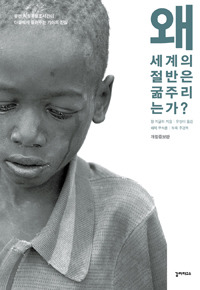
0.
This is the second book in my winter-break general-knowledge reading. This time I came to read a book dealing with the refugee problem and the food problem among social issues. It's not that I chose this book because of some grand dream. But it was among the recommended books in 'Yoo Si-min's Special Lecture on Writing' that I recently read, so I became interested. On top of that, the relief food I'd seen when I went to a UNICEF-organized fundraising campaign site a while ago, which had stayed in my memory, also played a part.
One of the biggest differences distinguishing people my age from people my parents' age is precisely the difference in 'food.' My parents' generation was the baby-boom generation. And up until that time, not everyone lived in an environment where they could worry less about food the way we do now. Of course, I know that even now there are many people worried about their next meal, but overall things have certainly gotten better than in the '60s and '70s. Even so, both within Korea and worldwide, there are still many people going hungry. This book is precisely one that makes you think about that 'hunger.' What kinds of causes there are, in what ways improvements were made, what failure cases there are, and what parts are difficult to solve. In crude terms, this book was talking about just how 'hopeless' it is.
In this piece I'm going to write about the reasons the refugee problem isn't being solved. Those causes are countless, but I narrowed them down to a few based on the book's content, and added a bit of my own thoughts and knowledge to complete this piece. I hope that after reading this piece you can establish, at least a little, your own personal values regarding the refugee problem.
1. Neoliberalism
The book criticized neoliberalism. Of course, I think most readers of this piece already roughly know what neoliberalism refers to. I've mentioned it before too, when I wrote a piece on Finnish education (see the link - http://milkrevenant.tistory.com/356), and to mention it again briefly, it's like this. Neoliberalism is a current that arose to reduce the inefficiency thought to have been created by welfare and institutional mechanisms. It also carries the meaning of returning, through 'neoliberal reform,' the many areas that aren't achieving minimum cost and maximum effect to a structure grounded in the 'invisible hand.' It might be quicker to understand if you think of it as market liberalism. Of course, whether this neoliberalism really succeeded at reform still remains a question. In education at least, it failed. The idea of reducing the cost that must be invested and seeing maximum effect was not realized; rather, many statistics showed that it appeared as a decline in academic achievement and a widening of gaps. On the economic side too, if neoliberalism's purpose was the enlargement of financial capital, it could be called a success, but if the purpose was to reduce the gap between rich and poor or to resolve social instability factors, it can be seen as a failure.
To cite the book's example: the form in which neoliberalism exerts influence on the hunger of impoverished nations can be seen in multinational corporations or financial capital that act contrary to ideal market principles, and the book gave the example of 'Nestlé (Nestlé),' which once nearly monopolized a country's powdered-milk industry. It recounted the story of a president whose campaign pledge to distribute powdered milk fell through due to Nestlé's non-cooperation.
It also mentioned that even when farmers residing in numerous African nations farm to the bone and try to sell their produce, the self-reliance of impoverished nations is impossible because multinational corporations dump their surplus products on impoverished nations at dirt-cheap prices. This is, sadly, something that can readily happen just by thinking about it. The scale of independent farmers is incomparable to the scale of large corporate farms, and on top of that, with a considerable portion of land having passed to corporations, the reality is that independent farmers who can expect any steady income are gradually decreasing.
Actually, the basic principle of neoliberalism is, in any case, to uphold market principles. It's not to grow financial capital. But the highest ideal of this market principle is an infinitely competitive market in which no monopoly or oligopoly occurs, and the side calling for deregulation is mostly the supply agents of markets where monopoly or oligopoly has already occurred. An infinitely competitive market is one in which anyone can produce and anyone can access, so price is determined solely by supply and demand, but an oligopolistic market is not like that. In most of today's market economies, there is no ideal infinitely competitive market. Especially with 'food,' not everyone can produce a similar amount, and so the price isn't uniform and only the multinational corporations capable of mass supply survive. On top of that, feed grain for the dairy and meat consumption of the many great economic powers plays a part here too. The author's words - that the grain a cow eats in one year amounts to the food on which one child could live for a year - were heartbreaking.
Personally, I heard for the first time this time of what the book called the Washington Consensus. This Washington Consensus broadly aims at four things, it says: privatization, deregulation, macroeconomic stability, and budget reduction. These four aim to accelerate competition and minimize state intervention. That is, as that happens, it becomes hard for new corporations to enter the existing market. Because the technology gap / wage gap / capital gap are so enormous, in order for a new corporation to emerge - it's an agreement for financial capital and giant monopolistic/oligopolistic corporations, not an agreement for poor people struggling to make a living. The word 'globalization' has such a 'nice-sounding ring' to it, but to me this globalization is an obstacle blocking the growth of impoverished nations. In the past the stage of competition was limited to within one tribe, within a city, within a nation, but now the stage of competition has grown to encompass the world - that is precisely globalization. This globalization brings about a widening of the wage gap, an expanded weeding-out of uncompetitive corporations, and so on. Of course, by the principles of the capitalist market economy it's correct that uncompetitive corporations disappear, but I wonder whether that's really the path humanity should pursue. I'm a person who wants coexistence. I dream of a society that can coexist even if it's a little different and a little lacking. A society in which some must live well and some must live badly is a society that has kicked away the chance for all to live well together. I think a society that develops while seeking a way for the many to live well together is more valuable than a world where the few live well.
2. Malthus's Theory
Anyone interested in economic theorists has probably heard of 'Malthus' at least once. Malthus is known as the person who wrote An Essay on the Principle of Population. He's the one who said, 'Population increases geometrically, but food increases arithmetically, so unless population growth is curbed, food will become scarce.' Of course, in the end his theory went astray. Neither did food-production growth fall below the floor, nor did population swell geometrically. The part where the book mentions this theory is precisely because of people who rationalize 'natural selection.' The author said there are several people who, based on Malthus's theory, advocate 'population control.' Underlying the thinking of people who hold the idea that 'unless the population of impoverished nations decreases, food will become scarce' is Malthus's theory. Malthus was not an economist who advocated that natural selection is necessary. He merely analyzed a phenomenon. He's an economist who predicted that the increase in food production would be insufficient relative to population growth. But his theory can appear as grounds for people who advocate that natural selection is necessary. And there are people who think that way now.
Whether Malthus's theory can serve as appropriate grounds needs a bit of consideration. The insufficiency of food-production growth and the sharp rise in population growth that Malthus spoke of in his Essay on the Principle of Population went astray from his predictions. Food increased more than he thought, and population increased less than he thought. I think these grounds are inappropriate. First, Malthus was not an economist who said population reduction is necessary. Malthus's intent was to say there would be a problem. I'd sooner understand it if one talked about survival of the fittest while mentioning Darwin's theory of evolution. But in the end I want to point out that even that problem of 'survival of the fittest' is not a problem that humans can decide before they're born. We're born without being able to choose the nation, place, sex, and so on we'll be born into. We're simply born. Depending on where that place is, depending on whose child one is born as, many things change. Can even this be called survival of the fittest? Don't they say the starting points are already different before competition even begins? The refugee problem is precisely this kind of problem. A problem of different starting points. The problem of being born into a situation where competition is utterly impossible.
3. Social Instability
1) Power Struggles
The causes of social instability are diverse. In every country there's a bit of social instability. The most frequent social instability the book mentioned is precisely the instability arising from the moral corruption of the 'warlords.' The country that left the strongest impression was Somalia. I don't know in concrete detail about the specific tendencies, movements, or incident cases of Somalia's warlords. But I have heard at least a little about their misdeeds. For example, regarding pirates, I recall there were cases of Somali pirates hijacking merchant ships passing through the Gulf of Aden and demanding money from the hostages' nations.
The book cites the power struggles of the great warlords as one of the reasons for this Somali civil war. It cited the incident in which, because of the warlords' power struggles, the UN twice sent peacekeeping forces to rescue the refugees within Somalia, but as the peacekeepers were killed or injured, the UN decided to no longer deploy peacekeepers in Somalia; and the point that even if one wants to deliver food, there's no safe, properly equipped port through which food can be delivered, so food can't be delivered safely.
Another power struggle is inter-tribal conflict. In fact, in Somalia's case too, the warlords' power struggles are connected to inter-tribal power struggles. But what I want to mention isn't tribal conflict confined to Somalia alone, but the inter-tribal conflicts spread across the entire African continent. One of the countless thematic maps of Africa I saw while studying world geography in high school is precisely the ethnic map made by Murdock, shown below. If you want to understand just why there's so much inter-tribal conflict, this one map is enough.
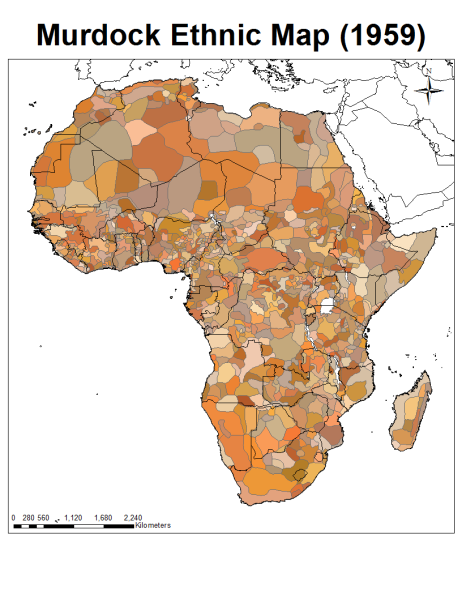
On this map, the thick lines drawn in 'black' indicate the territorial boundaries of present-day nations, and the differences in shading based on orange indicate differences between tribes. In the case of the Somalia just mentioned, about five tribes are included within its territory (the peninsular country jutting out on the eastern side of the African continent). Arid climate zones have a relatively low density of tribes per nation, but you can see that as you move toward tropical rainforest / savanna regions, the rift of that conflict is very deep. It's not marked on the map, but in Sudan's case, 'South Sudan' has separately gained independence. After independence, it's a region troubled by the endless disputes within South Sudan and with Sudan. I've heard several times about civil war within the Uganda region or civil war within the Rwanda region, and besides those, conflict in the Congo region comes to mind. The cause of this conflict is, as such, tribal, but religion plays a part too. Since tribe brings about a difference in language, if disputes over what to make a nation's official language are involved, religion brings about a difference in ways of life. It gives rise to differences in the institution of marriage, differences in the social status of men and women, differences in economic activity, and so on. Since many European nations once colonized these places, there are very many regions where Catholicism, Protestantism, Islam, and indigenous religions are mixed together. That's why power struggles are endless.
Also, while not in Somalia's case, in other countries' cases, when relief food is sent to whatever transitional government exists, there are cases where it isn't properly delivered to the people suffering hunger and government officials skim it off. This is a case where corrupt forces within government agencies are rampant. Looking at cases where, as government organizations grow bloated, there are many instances where they become harder to control, one can surmise that these problems come with considerable difficulty for solving all at once.
4. Aid Organizations' Lack of Funds
There are various organizations targeting the refugees of impoverished nations, but most organizations are short of funds. When those funds are short, the result appears in the form of reducing the areas of support. When the areas of support are reduced, in the end the refugees don't decrease. Also, I learned for the first time this time the fact that even when organizations have money, the amount of grain they can buy on the international agricultural market is limited. The WEP (World Food Programme) is an organization operated by the UN, and it's nothing new that this organization is reducing food support due to a lack of funds. Around the world there are countless people living on less than $1 a day in living expenses, but there's a limit to the funds that can support them.
- Forms of Activity
People who think most simply when they think of 'refugee aid' say, can't you just drop food from the air? But the starving are often in a situation where they can't ingest food even if they receive it, and especially in conflict zones, because access is impossible, dropping food is nearly a last resort. So in practice, the first step is to use injections to supply nutrients in order to activate the digestive organs, then get the organs back into a working state. After that they become able to ingest the food that comes in the packs we usually know about. This kind of food aid is the case we know best, and other forms of aid include building school facilities, eradicating diseases, civic education to enable women's participation in economic activity, and help establishing village self-governance bodies. Since these were things I'd seen whenever documentaries about refugees came out, they weren't entirely new, but it's only sad that the fact remains unchanged - that funds are short and they still proceed bearing danger. Somalia too is a region where UN peacekeepers were deployed twice and failed. Food aid organizations are providing support to various regions, but it's still not enough, they say. I don't remember exactly how short it is, but if funding has decreased to the point where support projects for two countries are being cut off, I think it's a serious situation. It's a situation where, without support, no means of recovery exists, yet they have to suffer such pain merely for the reason of being born in that country.
5. In Conclusion
This book describes the actual state of the refugee problem. It's writing about what causes there are, and what success cases and failure cases there were. Even among the soldiers who staged coups in their countries, there are different types. There are soldiers who agonized over how the country could be improved, and there are soldiers who agonized only over how they could expand their own power. Meanwhile, there's also discussion of the ways multinational corporations committed abuses, and it's a book through which you can learn how the harms of neoliberalism are revealed in the refugee problem too.
I think neoliberalism failed. That's because I made the judgment that neoliberalism is unsuitable for the method of 'coexistence.' But I can't force my thoughts on others. If someone asks me to state the reason 'coexistence' is better than 'competition,' it's hard for me to answer that conclusion. Because I've simply lived thinking that coexistence might be a slightly better way. The biggest thing would be to say it's related to people's good-heartedness. If someone lives without worry about money, while someone else lives worrying only about money, this is an unfair society. And it's an unhappy society for the one worrying about money. What makes humans different from ordinary animals is that they have reason, and I want to use that reason to help people in inferior environments. To help them acquire the ability and environment to become self-reliant. As the book says, the recently released refugee-prediction index will probably have a high chance of failing to be achieved when the predicted year arrives. Even if they say they'll cut refugees in half by '30, that won't easily decrease. Unexpected conflicts increase, and figures peaceful enough to integrate forces and stabilize conflict nations can't appear overnight. Even so, I think we have to find and do something we can. The start of that seems to be sponsorship.
Comments 0
No comments yet. Be the first.