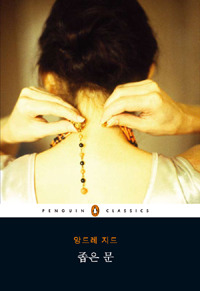
0.
André Gide, the name of an author of French literature I haven't read much of. French literature feels somehow rather distant. I've read a few works by Milan Kundera, who wrote in French, but I don't really know the writing of authors who lived their lives in French from the start. I just haven't read them. I haven't really read works by authors like Flaubert, André Gide, Émile Zola, Sartre, or Guy de Maupassant. The only one I remember is Albert Camus's 'The Stranger.' Strangely, I can only say there was no connection. The works of these authors, my parents' generation say they encountered in their school days. In particular, this 'Strait Is the Gate' was famous, so I heard at the Lunar New Year holidays that almost all the adults had read it. Still, on my mother's side of the family, for someone my age, I'm relatively well-read in literature. As for Korean literature I've really read a lot, and world literature I've read a little too. Even so, French authors, with the exception of Hugo, were distant from me. So, on that day when I went to my mother's family home for the New Year, at the moment when one work by this author I didn't know because I hadn't read him was discovered as an 'old book,' that is a book in 'vertical writing,' I made up my mind that I should read this work.
Enter through the narrow gate. For the gate is wide and the road broad that leads to destruction, and those who enter through it are many. How narrow the gate and how constricted the road that leads to life, and those who find it are few.
Matthew 7:13-14
1. The Story Structure
This 'Strait Is the Gate,' the book's title, refers to the 'narrow gate' that appears in Matthew chapter 7 of the Catholic Bible mentioned above. I don't remember exactly, but there was once a time this passage came up as the Gospel at church, and I faintly remember that on this day I resolved that, because the 'gate that leads to life' is narrow, in order to reach the goal as a believer one must live striving ceaselessly. The story of this book can be said to be precisely the story of reaching this 'narrow gate.' It's the story of three main characters who lived in order to reach the 'narrow gate.' The three main characters are Alissa, Jérôme, and Juliette; Alissa and Juliette are sisters, with Alissa the eldest, Juliette the second, and then the younger brother Robert—these three siblings—and they are relatives of Jérôme. The story begins in the manner of 'Jérôme' reminiscing about the past, and the first foremost subject is Lucile Bucolin. Lucile Bucolin is the mother of Alissa, Juliette, and Robert. To Jérôme she's an aunt by marriage, and it begins with him stating as 'calmly' as possible that the actions of this aunt, Lucile Bucolin, were actions that hurt his own mother's feelings. After Lucile Bucolin then runs off with another man, Jérôme's youth appears. In this youth there's the story of coming to love Alissa, the exchanging of letters in that situation, falling into conflict upon learning that Juliette likes him, and after that Juliette marries a suitor named Teissières, while Alissa and Jérôme love each other but don't marry. Afterward Alissa meets her death alone in a sanatorium in some region without revealing it to anyone, and then Jérôme, thinking of Alissa, meets Juliette. There Jérôme, inside the 'Alissa's room' that Juliette had prepared in her home, is asked to become the godfather of Juliette's daughter, 'Alissa,' and Jérôme and Juliette reminisce about Alissa as the novel comes to a close. The story after that is composed of the diary Alissa left behind.
2. The Eldest Daughter and the Mother, and Alissa's Catholic Life
The relationship between the eldest daughter and the mother is truly strange. Many scientists have researched this part, and their conclusion is this. Psychologists said that results showed the eldest daughter has a very high probability of self-identifying with the mother. If the 'mother' shows a happy figure the daughter is happy too, and if the 'mother' shows a slightly different figure, the eldest daughter follows along into that different figure too—those were the research results. For the eldest daughter, the figure within the household that can most resemble herself is the 'mother,' and by identifying with and learning that mother's figure, she comes to learn what a woman, what a mother, is. If you apply this theory to this work, you can see that Alissa went a little astray because of the relationship between Alissa and Lucile.
Alissa's mother, 'Lucile,' quickly puts on flashy clothes even after the death of Jérôme's father. Clothes that bare the chest, clothes that are red in color, and other various things—she gives off her own unique energy. Over this, Jérôme's mother was in a situation of criticizing, saying one can't be like that. Soon, when Lucile runs off with the 'young officer' she had let into her home, Alissa begins to feel negative emotions about the desires she instinctively comes to feel. Alissa, who believes in Catholicism, thinks her desires are at a remove from the realization of a religious life, and stressed by this she agonizes over how she can escape this stress, but the path she chooses moves in the direction of living a completely ascetic life, a life similar to that of the Stoic school.
As she moves toward an ascetic life, the role model she sets up can be grasped as Jérôme's mother. Though not the only one, Jérôme's mother, who appears quite impressively, didn't like Lucile's conduct. I don't remember either exactly how much time had passed since the death of Jérôme's father. But that isn't what's important. What's important is only that Lucile's mother heard a word of reproach from Jérôme's mother, and that Alissa understood her aunt, Jérôme's mother.
I'm not very well-versed in the Catholic Bible, but I can mention a few of what kind of thing the moral life the Bible fundamentally pursues is. This moral life includes a life of giving, a life of forgiving, a life of helping others, a life that isn't selfish, a life of sharing happiness with others, a life harsh on oneself but generous to others, a life of acknowledging one's own inadequacy and ceaselessly cultivating oneself, and so on. Among these, you could also add living a life not inclined only toward desire. But it's saying don't be inclined only toward desire; it's not saying to live a life that excludes desire itself entirely either. In that sense, the devout life Alissa pursues is at a remove from the original Catholic life. But what can be done—because the life Alissa pursues corresponds to an extremely ascetic life, Jérôme feels that it's hard to maintain any longer the relationship in which they had once even thought of marrying each other, and Alissa comes to make the choice of advancing down the path of asceticism she has chosen.
3. What kind of life should one live.
This novel's problem consciousness can ultimately be summed up as what kind of life one should live. And I think the title 'Strait Is the Gate' is like a kind of guideline the main characters must think about as they live. If so, the forms of life the author presents can be grasped through the characters. Three characters largely appear. Among them, Juliette, thinking of the marriage between her older sister and Jérôme, marries a man she doesn't want and lives a life wearing a mask. Alissa is a character who cannot accept the instinctive desires inherent in herself and feels anxiety about this. She lives a life silently following the choice she made in her own way, in a situation where the guilt arising from her mother's deviation strongly weighs on her. I think Jérôme is truly not easy to describe. Jérôme is the character type least well revealed in this novel. Although Jérôme is the protagonist, when you look at the parts where he makes decisions in his relationship with Alissa, for the most part he acts in the form of following Alissa's decisions. Rather than Jérôme being a passive character, this is also partly the result of his having quite respected Alissa's choices in his relationship with her. So I felt it's hard to carelessly devalue him. Also, you could confirm at the conclusion of the novel's content that Jérôme was not in a situation of having forgotten Alissa just because she died, and inferring from the fact that this novel's content begins from Jérôme's reminiscence, I think that rather than the focus being on revealing a character type, Jérôme's role as narrator is stronger, and at the same time the focus was on showing what meaning Alissa's thoughts and actions hold.
I have a question at about this point. About what kind of life is a valuable life, the life one should pursue. In principle, I think anyone's life is a valuable life. Even a person who feels their own life has no value. There was a time when my values were similar to Alissa's. Of course, there would be a difference in degree. It wasn't that I felt a strong desire for an ascetic life because of religious values. After I came to feel an inherent, instinctive desire that was quite hard to control and indescribable, I had agonizing over how I should handle this desire, and as one of those methods I once pursued an ascetic life. The expression of desire isn't done in a mature way from the start. At first there's a lot of trial and error, and the form of that expression too manifests in a somewhat rough, unpolished state rather than a refined form. Faced with this kind of desire, I agonized a lot at first. Then, after the thought came that I shouldn't express this desire at all, I had chosen the ascetic life. The reason this wasn't the right answer is that asceticism was inappropriate as a solution. Just like rivers that are blocked off with a weir and are rotting. And as I kept up asceticism, at some moment the thought crossed my mind, what if I let it flow, and now I'm living a life of letting it flow little by little. It's because I thought affirming my various selves rather than denying them is a somewhat wiser approach.
I think the perspective that can view this problem on a larger scale lies precisely in 'the perspective on the self.' Put differently, something like self-concept. In the end it's a problem of whether I accept myself or fail to accept myself. The moment I accept that the version of me that feels desire is also a part of me, the thought that I should hide this part, that I shouldn't show it, would lessen a bit. If we see that what Alissa aimed for was entering the 'narrow gate,' and that the life she aimed for was living a moral life different from her mother 'Lucile's,' then these pieces seem to fit together a bit. You could grasp that because a life of pursuing desire was a life that wasn't moral, she fought against herself her whole life.
I'm not sure whether, after reading Strait Is the Gate in one's teens, there will be a chance to reflect on the related issues. What's certain is that I didn't properly think the above kinds of thoughts in my teens. At a point when the agonizing I began in my late teens is now somewhat coming to an end, I think this book, rather than being a book to read and be done with in one's teens, is a book that can help organize the many thoughts and worries that come later. At the least, I get the thought that, in living, amid the need for restraint and regulation, appropriate release is also needed, isn't it?
That I'm only now finishing a piece I started writing in February is partly because I'm lazy, and partly because the writing didn't come easily. With this, reading liberal-arts books and writing over the winter vacation is finished.
Comments 0
No comments yet. Be the first.