0. Before getting started.
As one of the new projects I'm starting this year, I planned to write about authors who won the Yi Sang Literary Award / Dongni Literary Award but whose works I hadn't encountered. The reason is that, more than anything, I wanted to view works with a broader perspective regarding the 'exam', and on the other hand because I wanted to learn more about authors I might not know. So, the author I'll cover this time is one named 'Lee Gyun-young', but unfortunately, after reading everything and trying to find related material, there was far too little. The research is very, very lacking, you could say. I doubt he'll come up on the exam. To put someone on the exam there ought to be at least some research, but since there's literally no one who has discussed this person, it seems too difficult for an exam-setting professor to step in as a researcher of this author. Still, the novels were decent in their own way. There were many works with endings that find a prospect within a hard life.
1. About the Author
The author Lee Gyun-young lived a life as a historian. He's an author with a record of receiving the Danjae Academic Award for his dissertation 'A Study of the Singanhoe'. Unfortunately he passed away early, so he couldn't leave many works, but given that his body of work is treated as belonging to the 1980s (he debuted in 1977), I think it would be good to mention just two things about what he holds as a 1980s author.
1) The retrospective tale (huiltam)
If there are readers who can't immediately recall writing in the retrospective-tale form, I'd like to mention a work that's easy to recall. That's Yi Mun-yol's work 'Our Twisted Hero'. Our Twisted Hero is a work in retrospective-tale form that begins with the narrator recalling Eom Seok-dae from the past. The reason I mention the 'retrospective tale' is that one of the typical narrative techniques of 1980s authors at the time was the 'retrospective tale'. I really don't know why this was used so much. With this author too, when I looked at his works, I was amazed to see scenes of recollecting the past pop up in truly various works.
2) The subject matter of the father and the 'past'
In terms of subject matter, the relationship with the 'father' and the narrator's own 'past' appear especially often. Because there's the retrospective-tale format and the past-recollection format, the reader can't help but repeatedly encounter the narrator's childhood, and the 'father' here can be seen as an existence who was together with the narrator or protagonist but is full of regret. That's because the protagonist lives well up to the grandfather's generation but, crossing over to the father's generation, lives a hard life. They live a life short of money unless they sell land. So this father can be seen as a past that must be escaped. The father in the novels also continually shows an attitude of wanting the narrator-protagonist to get some kind of job and gain stability, or wanting him to enter a stable university. The protagonist, living while bearing such a family burden, appears in a state where it's hard to fulfill that burden. But later, as time passes and he revives memories of his father or converses with his father, the protagonist recalls his father's words that one must live remembering something of the past, or the novel ends with him listening to it beside him.
2. The Works
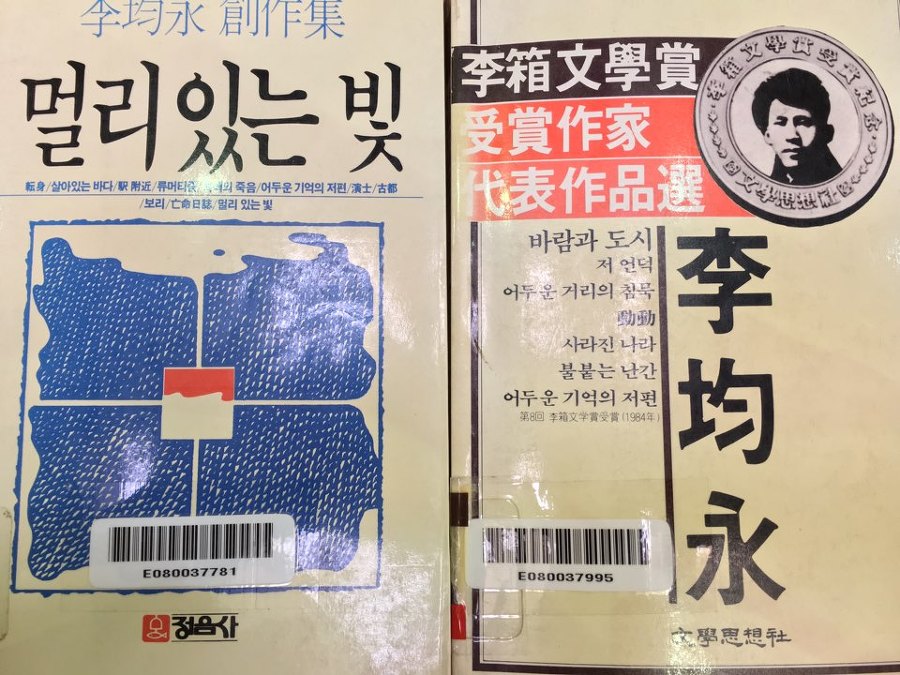
For reference, for these works I'll refer to both the Representative Selected Works of Munhaksasangsa (Munhaksasangsa, 1986) and Lee Gyun-young's creative collection The Distant Light and 10 Other Stories (Jeongeumsa, 1986), published by Jeongeumsa.
1) That Hill: A work dealing with the story of a certain university lecturer. Here it depicts a story in which the protagonist runs into his past girlfriend by chance and goes on a trip to the outskirts. Meeting his former lover and thinking about her, the protagonist's psychology of agonizing over whether 'love' is something that can change or cannot change is revealed. Through his lover 'Hye-uk', the protagonist again recalls the important values he'd thought of and longs for the 'street' where he used to be. And the novel ends with him climbing a hill in order to return to that city street. Overall a gloomy atmosphere is strong. It directly reveals the financial hardship of having insufficient income unless he tutors, because he didn't graduate from a prestigious university, and you can confirm that skeptical views about his own circumstances appear frequently.
2) The Silence of a Dark Street: The story of 'I', who lives in a boarding room, and 'Deok-ji', the daughter of a certain wealthy family. 'Deok-ji', since she sleeps with 'I' and they're practically dating, talks about marriage, but the protagonist 'I' says he has no such intention. However, the story mainly dealt with here is not this story with 'Deok-ji' but his own past story. It depicted how the situation in which his father's promotion is thwarted because of his maternal grandfather is tied to the early-1980s democratization. I think the strange-looking 'bridge' that appears at the end has the same properties as the 'Salgoji Bridge' that appears subsequently. Probably what this bridge holds is people's pain, history, and times. Especially in the ending part, through the part 'I answered that I'd wanted to show the vanished power and the vanished silence', you can guess that the title 'The Silence of a Dark Street' is connected to the protagonist's life.
3) Dong Dong: The protagonist of this work is a female protagonist; her mother is the owner of a tearoom, and a man called President Park is the one who supported her so she could set up this tearoom. The protagonist 'I' wants to leave this place but feels great regret at the situation of being unable to leave. At her mother's request to hold onto Miss Jung, saying Miss Jung's condition seems a bit off, she converses with Miss Jung, and the protagonist 'I' envies Miss Jung's freedom. In the ending part, 'I' meets Miss Jung at a house she visited out of longing for 'a man', and the novel ends with her feeling that afterward she wants to make 'a new start'.
4) The Wind and the City: The 'city' here seems to be City K, and the wind can be seen as a trace of the past that made the protagonist cough; the ending statement that he'll return to a 'warm city without wind' can be grasped as meaning that he'll now forget the hard things and try to live healthily. Here, the fact that marriage is chosen as the way to be able to return to the warm city felt to me like a somewhat peculiar novelistic ending.
5) Weathering: Weathering usually refers to the phenomenon of wearing away and disappearing over time. When rocks weather by wind, don't the rocks get shaved down? The weathering here can be grasped as the weathering of one's own life. To quote from the book,
Such a life of ours is like a river. At first it flows narrowly between both banks, shaving down mountains and even forming waterfalls. But gradually its width broadens, the banks become invisible, and the flow of water grows quiet and calm. At last, neither shaving down mountains nor breaking down banks, it meets the sea and, as if it were nothing, loses its own existence.
As one finishes the day's work and goes home, as one returns to a long-departed hometown, in that way our life returns to the sea. That sea, those mountains. Only inviolable nature remains. It exists forever.
- Weathering, pp.100-101
That's how it goes. In other words, the narrator says 'life' too returns to the sea and exists forever. Weathering means nothing other than life itself.
6) Salgoji Bridge: I mentioned it above earlier, but this Salgoji Bridge is a bizarrely shaped bridge. The footnote describes Salgoji Bridge as 'a stone bridge located a little above the east of Seongdong Bridge in Sageun-dong, Seongdong-gu, Seoul', so named because its shape looks like a salgoji (arrow-stuck) bridge. The narrator expressed Salgoji Bridge as the only 'scar' the school years left him, like a spot where an arrow struck. But as the narrator comes to feel skepticism about his stable, comfortable life, and to realize that graduation is the single knot that erases his life, the space where he feels his agonies are still 'alive' can be seen as Salgoji Bridge. It seems to say that the claim it'll all end once you get a job and settle down is a vain story.
7) The Shade of Bukmang: The narrator 'I' is on the way to his mother's funeral. That town is a place called 'Yulchon', and on the way to Yulchon the bus comes to a stop. And learning that the vicinity was a cremation site, he arrives at Yulchon with a slightly ominous feeling. On arrival he bought rice cakes that some old woman was carrying on a tray and selling, but after hearing from a certain man that they were ominous rice cakes, he gets a strange feeling. Afterward, through that man he arrives at his mother's house, and after closing his mother's eyes, the story ends with him feeling dizzy amid the surrounding sounds. Looking at the part where he recalls the dead fish in the aquarium he saw while talking with the man, you can guess that this dead fish symbolically reveals his mother's actual death and the fatigue the narrator himself feels coming to this Yulchon. But it's a shame that I can't quite organize concretely what message this novel is trying to convey.
8) The Vanished Country: A novel in which the protagonist-narrator unfolds the story of his own child in a retrospective form. Because the child's back is bent so it no longer grows and, in his expression, has a 'hideous' appearance, he tries to confine and protect the child within the castle of the home, but he's a narrator who realizes this is impossible and in the end says he killed the child. In that he realizes that, while he hates others' gazes and fingertips, those 'others' gazes and fingertips' in fact originate from himself, I think a self-reflective character is revealed a little. I think the expression 'the vanished country' can be grasped as roughly a figurative expression for the absence of the 'child' he was raising.
9) Before Balk: It was quite a folkloric story. In a way, I think this kind of story is a work that, in the old days, would have come from an author like Kim Dong-ni. Quite an 'Eastern' subject matter, perhaps. I'm not sure in what aspect I can summarize this work, but from the line saying that if 'Balk' is alive, the country of Michuk will also revive, it seems more appropriate to grasp 'Balk' not simply as a being holding divine power but as a primal energy.
10) The Ground (Teo): The story of 'Yun Ik-sang', an artisan who makes knives, and Yi Sang-no, who was formerly an 'outside-the-wall' man (a lowborn). I think the title 'The Ground' is both a word that reveals the novel's spatial setting and at the same time signifies a 'symbolic space'. Mentioning that there are no secrets in the world, Sang-no tells Yun Ik-sang that he'll use the money he's gathered for a senior center and an orphanage. To me, this novel was the warmest novel. I think it was a novel that showed communal values. And in the process of revealing that, I think the part where the conflict between the characters that appeared early in the novel is mended also appeared plausibly. I think what the final sentence, 'For a first snow it was bountiful', implies is that they've now become 'warm people together'.
11) The Burning Railing: It's the story of 'Bae Jong-gi' and 'Yi Sin-uk', but within this story the stories of Sin-uk's grandfather and father are revealed together. The 'father' I mentioned as the author's subject matter can be seen as Yi Sin-uk's father; back when Sin-uk's grandfather was serving as an assemblyman, Sin-uk's household was the biggest house in the neighborhood, and because the village flooded every year and got submerged, Sin-uk's grandfather did flood-prevention construction, and as the construction went on funds ran short, but with the villagers' help the embankment was completed. Afterward, as time passed, on the strength of Sin-uk's grandfather's good reputation, Yi Sin-uk's father Yi Jeong-jun also tried to take up an assemblyman's life but failed time and again, so the family fortunes declined, and, left with only past glory, the family barely sustains its life through Yi Sin-uk's civil-servant work. Meanwhile Bae Jong-gi had lived a gangster's life (the Chilseong gang) in the nearby city, City K. He makes money through protection fees, profit dividends, money extorted from shops, and the like. And after meeting Yi Sin-uk, telling Yi Sin-uk that 'Imbi Elementary School' is his own past, in order to repay the kindness he received in that moment from Yi Sin-uk's grandfather, he often gives Sin-uk money for surgery for his mother 'Neungju-daek' or money to help with household expenses. Meanwhile Yi Sin-uk's younger sibling Yi Su-jin struggles to escape the stifling life in Imbi but, realizing this doesn't come easily, personally experiences the world's hardships. As the expression 'desolate' suggests for a house without money, Yi Sin-uk's house no longer has a lively energy, but thanks to Jong-gi's presence Sin-uk gains a bit of joy. It's even remarkable to grasp that Jong-gi coming to Sin-uk's house, helping with Sin-uk's life, and even keeping Jeong-jun company are all in repaying this kindness. However, Bae Jong-gi, witnessing his little ones (subordinates) suffering, feels anxiety and begins to feel uncertainty about his own life. Afterward Jong-gi disappears together with Su-jin and sends Sin-uk a letter along with money, telling him to use it where needed, and Yi Jeong-jun decides in the end to sell the house. Through a conversation at the embankment, Yi Jeong-jun tells Yi Sin-uk that his own generation is over and now it's for Yi Sin-uk to begin a 'new life', and the novel ends.
The 'embankment' functions not simply as a flood barrier but is, to Yi Jeong-jun, an existence like a legacy of the past; by showing the situation in which the present can no longer be protected through this legacy of the past, we can see that the 'father generation' that is Yi Jeong-jun no longer has power. Also, the fact that the story between Bae Jong-gi and Yi Sin-uk appears as a retrospective tale is, I think, this author's novelistic characteristic. The selling of the house can also be seen as signifying that the past generation no longer has a place to stand.
12) The Far Side of Dark Memory: Reading the novel, I came to understand a little why this was evaluated as a postwar novel. What the title 'The Far Side of Dark Memory' signifies is the narrator 'I's' memory of having been separated from his younger sibling back when he was in an orphanage in the past, and of wandering for a long time trying to find that sibling. The novel's content is filled with him going around meeting people in order to remember why on earth he had come to Imun-dong. Recalling the name Park Hye-su, he recalls Miss Min, whom he'd met at a bar, and goes to meet Miss Min again, and through conversation with Miss Min, confirming the shared status of being an 'orphan', the novel ends. A novel where I felt the scars of war are still alive—there was 'Mother's Stake', which I'd read before, but that work was filled not with his own story but with his mother's story and the story of his own very early childhood, whereas this work differs a little in that 'I' becomes the protagonist. In a way, this work might also serve as evidence that even in the mid-1980s, when this work received its award, there were still many people carrying the scars of war.
13) Barley: Barley can be said to be the protagonist's most concrete memory regarding his father. What symbolizes the father, who sold off all the land where 'barley' was planted to send his children to school, is precisely 'barley'. Siblings like Yeong-suk and Min-gi who appear in this work lived dreaming of life in the city, but the protagonist-narrator 'I' (Seok-gi) did not, and because of their father's funeral, Min-gi and Seok-gi walk through the barley field, reminisce about the past, and the story ends. Recalling their father's past words that one must not forget barley as he spoke of barley's tenacious vitality, the brothers, Min-gi and Seok-gi, think of that past and close with a hopeful ending.
14) The Distant Light: This novel left me a bit depressed, but now I'm fine. This novel reveals the life's pain, loneliness, and sense of burden that the protagonist 'I', the eldest of the family, experienced. The family wanted to send me to university, but after entering a second-tier university and saying I couldn't even get a proper job, I gave up university and went to the army; the days I lived to support my younger siblings; loving a certain younger sister but, in the moment I heard from that sibling the words 'I never thought of you (oppa) as a man'—through these you can grasp what my life was like. In the ending part where it says he walked while gazing at 'the distant light of the stars', you can tell that the protagonist, holding a purity with dreams like a teenage boy, will go on living well.
3. In Closing
For now, since reference material was greatly lacking there are only a few pieces, but I read and wrote. Among the protagonists in the novels, many are placed in a situation of having to rebuild the family. And this sense of burden is heavy. At the same time, they're figures who have difficulty fully realizing the family's expectations. But you can tell that they ceaselessly made an effort. Seeking out the light, recalling barley, or recalling the embankment—these are precisely such instances.
This work will never come up on the exam. Since the very number of people who've researched it is so few, and given that the pool of exam-setting professors is somewhat fixed and things turn within that, it'll be hard for novels with no researchers like this to come out. But I think this author's novels may have meaning in a hard era like the present time. Life is always unstable and there's much to do, but as the protagonists' fathers said, I think it gives the message that one must live while not forgetting the things of the past and making one's own kind of 'thing of the past' that I too can pass on to the next generation. Life doesn't change dramatically. But at some moment, life will change.
References
Park Jang-rye, The Hometown Representation in Lee Gyun-young's Novels, Korean Language and Literature No. 94, The Society of Korean Language and Literature, 2015
Lee Gyun-young, Yi Sang Literary Award Winning Author Representative Selected Works: The Wind and the City and 11 Other Stories, Munhaksasangsa, 1986
Lee Gyun-young, Lee Gyun-young's Creative Collection: The Distant Light and 10 Other Stories, Jeongeumsa, 1986
Comments 0
No comments yet. Be the first.