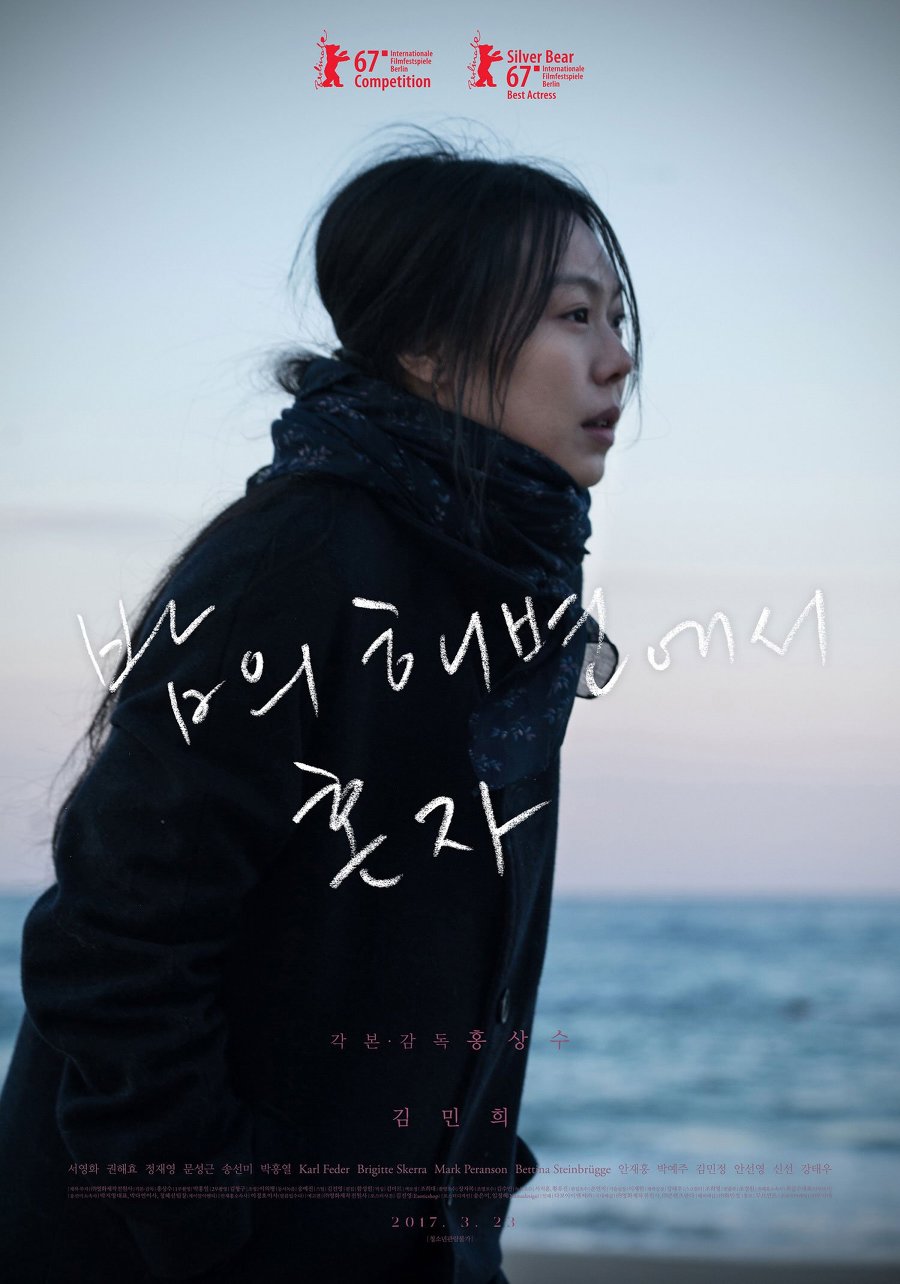
-1. A Controversial Work
This film is a controversial work. It's a film that came out as the affair (love) between actress Kim Min-hee and director Hong Sang-soo erupted, and it's a controversial work because there's enormous room to interpret it as autobiographical. Hong Sang-soo has not yet divorced. But his love with Kim Min-hee was made public, and in the end people come to see the actual affair in this film. People also say, what on earth did Hong Sang-soo's wife do to deserve this? In other words, isn't he even sorry toward his 'wife and children'? This ties into social ethics, and it's something that's hard to accept given the sentiments of our society. But apart from those social sentiments, I was indeed curious about the film. Because I was curious what story it was trying to tell.
I wouldn't have watched this film if this incident hadn't erupted. But that incident made me interested in this film. I think that all 'works of art' are ultimately one method of self-expression. Whether that work of art is a painting, writing, or music, I believe a certain part of one's own life is contained in it. From this perspective of mine, I watched this film too thinking self-expression had gone into it.
0. So,
I watched the film on my way home from school. There were largely two things I'd thought about before watching this film. One was self-rationalization/self-pity. There was less of 'self-pity' or 'self-rationalization' than I'd thought. Actually, thinking there might be a lot of those parts, I'd worried, 'Oh, what do I do if I feel a bit uncomfortable watching it,' but unexpectedly that wasn't the case, so I could just watch it straight through. The second was the question of whether Kim Min-hee would act or show herself. This question was only about half answered.
I organized my thoughts a bit based on the notes I took while watching the film. The discussion of the film is contained in this piece. I recommend reading this piece after watching the film. Of course you could read it even if not, but for this film in particular I'm a bit worried about that. The content is so sensitive.
1. 'Alone'
The title is 'On the Beach at Night Alone,' yet the scene of actually walking the beach at night appears only once, in Hamburg. All the rest of the beach scenes appear only in the 'daytime.' Perhaps that's why Younghee (Kim Min-hee) gives off the feeling of being 'alone' even when she's with other people. That is, the 'alone' spoken of here doesn't mean being alone in space and time, but being alone mentally. Throughout the film Younghee has almost no time 'alone.' In Hamburg, the times she's alone are when she steps out of the cafe to smoke for a moment, when she washes up in the bathroom, and when she watches a film in Gangneung. In fact, if one is given the eyes to perceive 'Kim Min-hee' as an 'individual actress' who - supposing she's a protagonist not actually caught up in an affair - holds the feeling of loving someone, then her feeling of being 'alone' was so overwhelming to my gaze and my emotions that anyone could fall into the protagonist 'Younghee's' 'loneliness.' A truly fundamental problem - even when we're with someone, we often get the 'feeling of being alone' - and Younghee gives it off throughout the film. When drinking, when talking with someone, and all the more when she's on the beach. So ironically, even apart from the single scene of 'on the beach at night alone,' I felt Younghee was always alone. And alone somewhere near a beach, at that.
And this feeling of being 'alone' is also abetted by the spatiotemporal setting of 'a winter sea.' In Part 1 (Hamburg), it's because of the uncertain waiting, since that person said he'd come but she doesn't know when he'll come, and because of the uncertainty of not knowing whether that person thinks of her the way she thinks of him; in Part 2, because time has passed and it's all become the 'past,' she reveals - holding the thought that all men are 'the same kind of person' who think of nothing but that - the fact that she is 'alone,' at drinking tables, in cafes, while smoking, lying on the seashore.
2. Struggle
If I were to express Younghee's various images in a single word, I could sum it up as 'she struggles.' She thrashes about in order to live 'as herself.' In Part 1 in Hamburg, 'Younghee,' listening to her older friend's story of having slept in separate rooms from her husband for ten years, doesn't deny that 'she herself' also has desire. In Part 2, after returning to Korea, she meets people and uneasily pours out the thoughts and emotions she'd been holding. The 'uneasily' I speak of here doesn't so much mean that Younghee's state is unstable, but rather strongly carries the sense that she's wandering. For Younghee, who has no proper place to settle, Seoul is no longer a livable space, and the fact that 'Gangneung,' where the seaside is visible, emerges as the setting tells us it's the most suitable place for this 'struggle' - far from Seoul, with little occasion to meet people. So Gangneung is at once a space of escape and the most suitable space for her to struggle 'alone.'
The owner of the bookstore she meets in Hamburg is quite impressive in this part. Jiyoung's explanation that 'she has cancer but is living with composure' is, in fact, a kind of encouragement given to 'Younghee.' Encouragement given to Younghee, who came to Hamburg because she's having an affair. In Part 2 in Gangneung, encouragement for Younghee emerges in the conversations with senior Cheonwoo, older friend Junhee, and senior Myeongsu. Things like 'you've become more womanly,' 'you've gotten prettier,' 'you've matured,' 'it's too much of a waste of your talent to quit work like this.' Even after hearing all such words, Younghee desperately accepts being 'alone.' That's why she lies on the sea.
3. The Affair, but an Affair That Doesn't Appear
Probably the biggest issue many people who watch this film come to think about is the actual affair between Hong Sang-soo and Kim Min-hee. But, since it's a film for now, I tried to focus on the film itself. In the film, the 'affair' never actually appears 'in reality' within the film. Even the scene where Younghee meets again the director she loved appears as a 'dream' Younghee has while lying on the seashore. But the many emotions she must experience and bear because of that affair, Younghee reveals very simply and, at the same time, with depth. Among the films Kim Min-hee has appeared in, the only one I'd seen was 'Very Ordinary Couple,' so it's too difficult for me to make evaluations like this actress's acting is very outstanding or remarkable. But in this film at least, she reveals with great depth the emotion of that 'affair' whose substance isn't concrete. I don't know how other viewers felt, but throughout the film I could find in Younghee's emotions the image of someone trying to accept her own love, which is called by the name 'affair.' To no one - even if it's called 'affair' by others - love is love.
4. The Qualification to Love
At a drinking table that includes older friend Junhee and senior Myeongsu, Younghee says, 'People who don't even have the qualification to love, people who don't even have the qualification to be loved, live clinging to a little hope,' revealing a negative view of such a life. To this, Myeongsu's girlfriend counters by asking what qualification love needs. She counters that love is, from the start, something done between such inadequate people. Younghee has a lot to say on this point, but only answers, 'If you seem not to know much, stay quiet.' Younghee too once, as an inadequate person, committed an affair under the mask of love with a film director, but that has now become a wound and a thing of the past. That's why what she says - 'fellows who don't even have the qualification to love try to love' - is both a sneer at herself and her own cry toward others.
Personally, this was the scene that made me think the most. Because it made me reflect on what on earth the qualification to love is. Before that, I'd never agonized over such a thing. Before agonizing over the qualification to love, I was already loving. But watching the film, and after watching it, I keep coming to ponder the 'qualification to love.' I come to ask myself whether, before loving someone, I'm living an upright life.
5. Self-Expression by the Name of Film
I agonized a lot over whether to view this film as a film, or as nonfiction that unpacks one's own story. I decided to view this film simply as a 'film.' A similar case would be a novel like Shin Kyung-sook's 'The Lonely Room.' The biggest reason for viewing this film as a 'film' is that, rather than the logic of 'self-defense' mainly appearing, the focus is placed on the 'feeling of being alone' that Younghee feels. Her simple yet deep 'images of being alone' made me view this film as an art method called 'self-expression' while at the same time seeing it as art.
People who've watched many of director Hong Sang-soo's films may think this way. Characters with more distinct individuality than in his previous works, the 'scene of walking alone and overcoming sorrow,' the director's expression of desire and love, and so on are examples of that. Among these I thought of it as an expression of 'desire and love.' The director who appears in Younghee's dream in the film regrets. I see it as Younghee's wish, but in any case the director appears in a scene of regret. 'Younghee' too regrets her 'self that didn't wait,' yet cries out trying to accept it. But I don't really know whether the real-world director Hong Sang-soo and Kim Min-hee are like that. Did Kim Min-hee really wait in Hamburg? Did she wait for the silent Hong Sang-soo? I don't really know. Because they have now made their love public.
6. In Closing
Younghee's story - that she didn't used to drink beer but, returning to Korea, found beer had become a bit tastier - shows her wandering and ends with an uncertain outlook, and in that it doesn't withdraw its contemplative gaze. In this sense the film had no intention of ending this love 'positively.' It's a kind of Hong Sang-soo's 'own story' about love and desire, you might say.
I don't view the 'affair' between Hong Sang-soo and Kim Min-hee badly. One can say social ethics have gone wrong, but if one says their love itself is a love that must be cursed, that would be cruel to the two of them as well. I think the two of them began their love thinking 'it will be cruel.' To people like them, I don't want to judge their actions by my own values, saying 'you made the wrong choice.' Because I believe the institution of marriage is the greatest mistake among the institutions humans have created. It's not that I defend their act of having an affair. But it's just that I don't oppose that act of having an affair either.
Tomorrow, if time permits, I'm going to watch another, recent Hong Sang-soo film, 'Yourself and Yours.' I don't know his film world well, but this affair seems to have made me hold a pure curiosity about him. With half expectation, half worry.
Comments 0
No comments yet. Be the first.