0. The backstory
I'm a fan of director Lee Chang-dong. I prefer works of his like Green Fish / Peppermint Candy / Poetry / Secret Sunshine / Oasis. I love how he unravels that indescribable plainness and honest stories through realism. One day, as usual, I was bored, and I searched Lee Chang-dong online. And this film came up attached to it.
In the year this film came out, director 'Yoon Ga-eun' received the new director award. After watching the whole film, that makes sense. I get the feeling this is also a first for such a feature. There was no place to rest in the middle, so much so that it was actually hard, and I couldn't let my guard down. Setting these feelings aside a bit, if I were to first evaluate the film itself, I think it could be summed up as 'the children are young, but the content wasn't young.' It's a shame that a film like this isn't well known to people, but I'm glad it seems to be an opportunity to watch it like this and tell those around me. I think it might be one of the few films that can be shown to almost any generation without distinction.
I wrote about this film centered on a few keywords. I tried to revise it as best I could, though I'm not sure it came out well revised; it would be better to read it after watching the film.
1. A coming-of-age film
The keywords for understanding a film can be diverse. Among them, I'd like to choose the word 'coming-of-age film' first. This can be seen as the word of a person with a rather literary way of thinking. Just as Hwang Sun-won's 'The Shower' is called a coming-of-age story, I grasped this film as one focused on the growth of children. To talk briefly about another film, when I watched 'Moonlight' a while ago, I also used the word 'coming-of-age film.' The reason is that the protagonist 'Chiron's' growth appears. Physical growth (the process of aging) and mental growth (the process of forming one's identity) correspond to that growth. In 'The World of Us,' the coming-of-age-film aspect corresponds to mental growth. The growth in forming the relationship between Sun and Jia. The film, among those, deals precisely with 'relationships.' Sun appears within the film as having no friends. In the scene during dodgeball, where she desperately wants 'my name' to be called in order to decide the teams but it's only called at the very end, the camera angle captures 'Sun' together with her classmates. It simply shows it. But it also shows that no one can solve this. The friend 'Jia,' who comes into the life of such a Sun, approaches at the moment when Sun stayed behind cleaning on the day vacation started. The two quickly begin to grow close.
2. Bullying
We too can't know why on earth Sun is bullied. The film doesn't deal with that reason. It doesn't show the past story of why on earth Sun is ostracized by Bora's group, why on earth there are so many scenes of her being alone and not mixing with other friends. We only come to know through the scenes that Sun isn't one to mix with the other friends. Meanwhile, the new friend 'Jia' who approaches this 'victim' is similar to her in that she too was bullied in the past. But the countless stories the two shared during their close days, and the facts about each other that they witnessed, become the trigger that makes the relationship go further off track once vacation ends and the semester begins. And so Sun continues a friendless life again. The problem is that Jia begins a friendless life.
Bora (she's a really bad kid) starts to dislike Jia after the day Jia got a perfect score on a test (an expression meaning she got nothing wrong). The audience watching the film sees, with frustration, the way she little by little excludes Jia. On top of that, as past incidents become known one by one, they only grow more distant. We can only watch this kind of bullying problem. It's because it's a relationship among children. It's adults who say 'bullying is wrong,' but it's also a problem most adults face that they can't properly explain why it's wrong. If you don't want to form a relationship with Jia because of the feeling of disliking her for continuing to lie, is that Jia's fault, or the fault of the children who dislike Jia, or, if not that, the adults' fault? I think the children are partly at fault, while the adults too are at fault. The bullying within the 'class' that appears in the film shows points that are very hard to explain by any single cause. The fact that Sun, being poor, can't give an expensive 'birthday present,' the fact that she isn't very good at studying, the fact that she has no cell phone—these are things that make the children feel less fondness toward Sun. But this is far from a problem Sun can solve alone. As in many cases, here too the adults' problem is mixed in.
3. The adults
1) Sun's parents
The father lives steeped in alcohol. And he has a deep conflict with the grandfather. Meanwhile, the mother runs a snack shop. Sun's family lives each day diligently, but their circumstances aren't comfortable. The location of the house Sun lives in shows this very realistically. Sun, who invited Jia to her own house, walks up together worrying whether it isn't hard. A neighborhood quite high up even within the city they live in, a household that isn't comfortable but just lives day to day. Here it's actually hard to enjoy big change. The benefits of welfare aren't visible either, and Sun's father, who sits drunk on a pedestrian overpass, barely returns home only because Sun tells him to go home together. Even when the grandfather passed away, not many people came, so in that respect they're a lonely family, and this is depicted very realistically. Was I the only one who got the feeling that there must be very many such families?
2) Jia's parents, grandmother
Jia's parents don't come to see her much. It looks like the grandmother does almost 80 percent of raising Jia. In that Jia's parents appear only once in the film, Jia's grandmother's words 'children should be raised by their parents' pierce the heart. But is it unavoidable? Jia grows up receiving insufficient love from her parents. The grandmother tells Jia to stop fiddling with her phone, but Jia has nothing else to play with. That's probably why Jia's 'big house' looks empty. The grandmother's words—that just as there was a lot of bullying at the previous school, she seems worried because there's a lot of bullying at this school too—symbolically reveal the story of adults who know Jia's condition but can do nothing about it.
3) The homeroom teacher
The teacher is the adult with the least presence in the film. She doesn't concretely know what's happening in the class, and she doesn't show any effort to know what problems the students are going through and how to solve them. This is probably the director's intention. It's not that there's nothing at all adults can do in children's relationships, but it seemed to contain the thought that, nonetheless, the children must work it out. The teacher is in fact incompetent. Because she had no idea at all until things had progressed this far. Yet why do I feel this is so realistic? Maybe it's because of my head, which remembers that there were many incidents like this.
4. Wounds and recovery
The protagonist of this film is probably 'Sun.' Sun wanted to recover the relationship. When she takes the gimbap her mother packed for them to eat together and goes to Jia, who is alone, and when she can't sleep at night and takes out the thread to make a thread bracelet again, Sun still wants to recover the relationship. In that respect, Sun doesn't want to let go of the good memories with Jia. And the friend who doesn't want to let go like that is more desperate when it comes to recovering the relationship. Nonetheless, as the film heads toward the end, it shows the two exposing each other. With Jia, who said her father is an alcoholic, and Sun, who says Jia didn't even go to England and was bullied at her previous school too, the endless mutual exposure of the two comes to a close. And so the film shows the dodgeball scene once more. This time there are two students being ostracized (Jia and Sun). The camera shows the two alternately. And when Sun courageously says 'her foot didn't go over the line' to the kid who claims Jia's foot crossed the line, and Jia gets called out, Sun and Jia stand side by side at a distance. The two gaze at each other little by little. The camera shows that gazing scene.
5. In closing
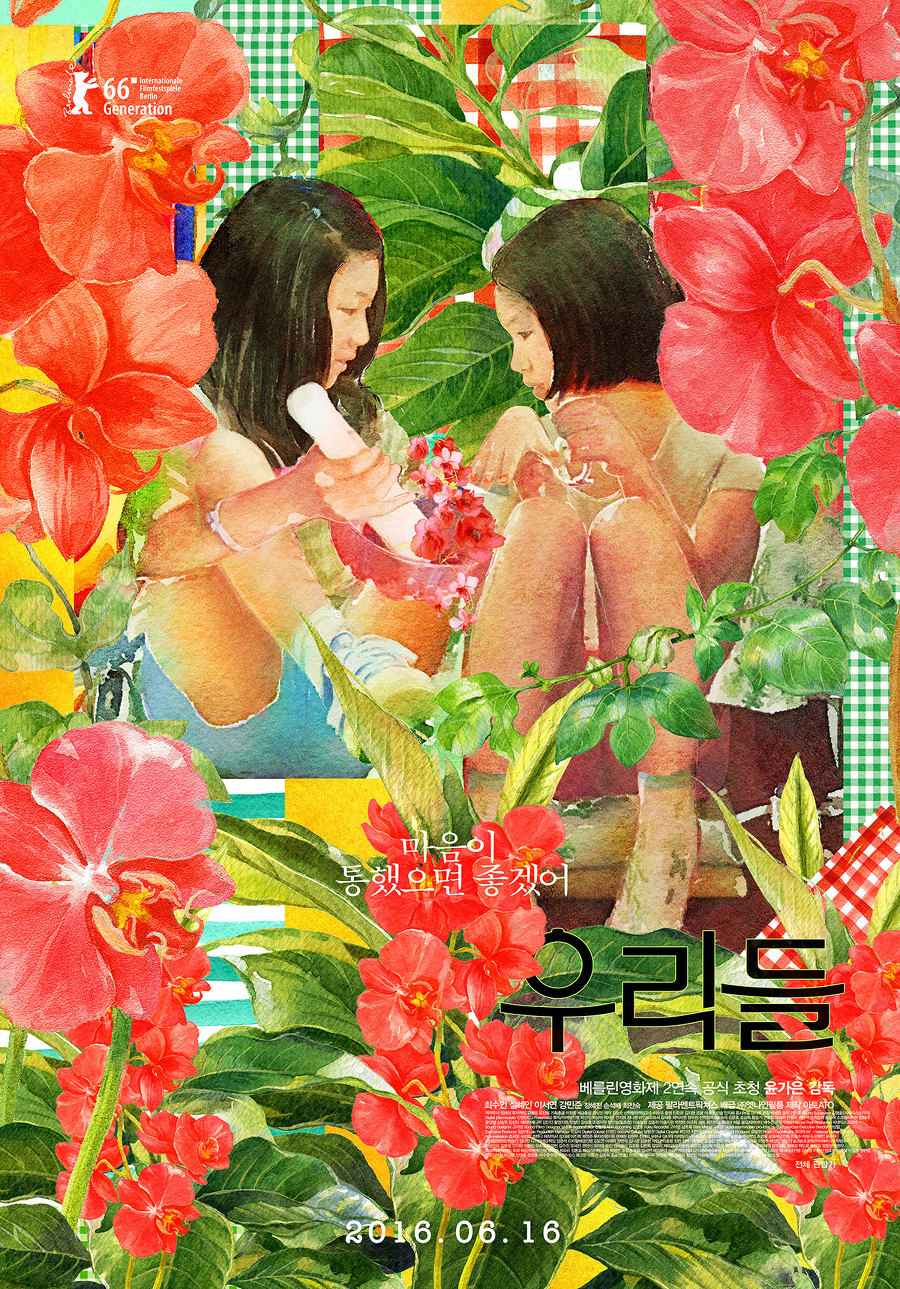
To publish this piece, I downloaded the poster image. And then, looking carefully at the poster again, I could see it's a scene of Jia applying balsam-flower dye to Sun's nails. But that's strange. The 'balsam-flower dyeing' that appears in the film is something Sun does for Jia. It's not something Jia did for Sun. That is, as a single audience member, I felt the urge to interpret this poster. Perhaps the fact that Jia is grinding the balsam flower to dye Sun's nails means that the two's relationship has recovered, or, if not that, it could be the wish of the director or the stager who hopes it will recover. I can't be sure whether this interpretation is correct, but since the 'balsam flower' is clearly the flower that appeared when the two's relationship was most intimate, I end up projecting this kind of wish.
The dodgeball in the gym class, the film's final scene, doesn't directly connect the two. It ends only with the scene of them gazing at each other. In that respect, this film is not one that presents any concrete conclusion. It simply shows. Leaving a sliver of possibility, just as at the very moment when the relationship seems all in disarray and impossible to recover, it's as if Sun and Jia, the subjects of the relationship, can recover little by little with hope. Perhaps the relationships between me and the people around me are like that too. Even if conflict arises and things twist a little and become disordered, I get the feeling that someday it can be recovered again. I still believe it, and I want to keep believing it going forward. That I want to keep my relationships with all the people I form relationships with going well. That even if conflict arises, there's the energy to resolve it well. In that sense, what Sun's younger sibling Yoon says—while tending to a 'puffy swollen' state after getting hit in the eye while playing with a friend—is significant. "He hits and I hit and he hits and I hit, so when do we play? I want to play."
Comments 0
No comments yet. Be the first.