- Let me say in advance: for a while I don't plan to write long pieces. I'm going to try to focus on extracting my thoughts as concisely as possible.
Director Hong Sang-soo's films are known to be largely based on 'improvised scenarios.' For a more detailed explanation from someone who has experienced it, there's a part on YouTube where Yoo Jun-sang appeared on Knee-Drop Guru and talked about working with Hong Sang-soo, so I won't go into detail. After all, what I want to talk about is the 'improvisation' of the scenario. A scenario being improvised means that many parts aren't fixed exactly by a script, and the story is created to suit the moment as it goes. Looking at the recent works that way—Right Now, Wrong Then; On the Beach at Night Alone; Yourself and Yours; The Day After; ('Claire's Camera' I haven't seen, so I won't mention it)—you can tell the subject matter clearly involves an 'affair' with some man. But the points of view of these films are not all the same. In one film it's a man, in another a woman; that is, it goes back and forth. It's not a story leaning to only one side. 'On the Beach at Night Alone' was focused on Young-hee (Kim Min-hee), but 'The Day After,' you could tell, has the angle set almost entirely around Kwon Hae-hyo. Of course, the fact that the gaze also goes to Kim Min-hee (Areum), Kim Sae-byuk (Chang-sook), and the wife (Cho Yun-hee) in between made me wonder whether it's a similar character composition to 'Yourself and Yours,' which I'd seen before, in that multiple members of the opposite sex form relationships around one person of the opposite sex. But in that it deals with the story of a married man, the essence of the story is clearly different.
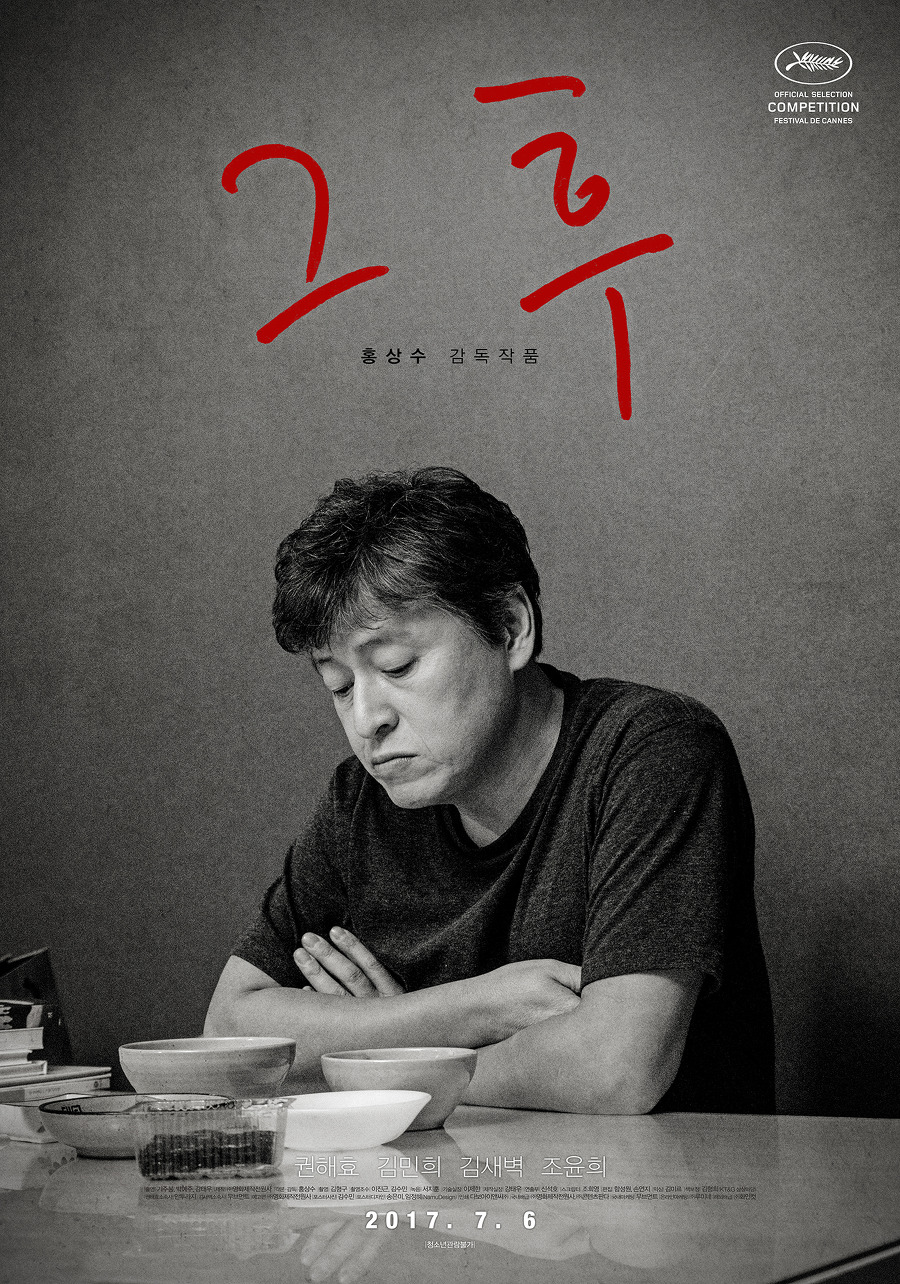
The film begins with Kwon Hae-hyo's breakfast. Only, the fact that this breakfast is almost a 'pre-dawn' meal is somewhat worth seeing. In an atmosphere of having woken up alone, he simply has a meal of rice and the three side dishes plus soup seen on the poster. The wife's question of why he got up so early soon turns into the question 'you've got a woman, haven't you,' and Kwon Hae-hyo says no and heads off to work. That man was having a relationship with another female employee at the publishing company where he is the boss, and from the scene of him going to work at the publishing company, the film alternately shows his relationships with Kim Sae-byuk and Kim Min-hee. You could call it a very Hong Sang-soo-like development: at first the two stories (the story of meeting Kim Min-hee, the story of meeting Kim Sae-byuk) are intercut, and later, when Kim Sae-byuk happens to run into Kwon Hae-hyo near some restaurant, the two parallel stories merge into one. I felt a freshness in this film's unique composition that's hard to put into words. Only, I still have doubts about whether the audience can fully accept that part.
The book Kwon Hae-hyo hands to Kim Min-hee at the end of the film is Natsume Soseki's 'And Then' (Sorekara). Explaining the whole content of the book is a bit much, but at any rate the commonalities seem to be that both take an 'affair' as their subject, and that the male protagonists of both works appear to draw vitality and energy in their lives from the single force called 'love' within a seemingly listless daily life. In the end, the title 'The Day After' can only be interpreted in various ways. It's the day after a relationship ended; it's also an expression of the emotions Kim Min-hee felt when she went to find Kwon Hae-hyo again 'the day after'; and it's also the 'day after' in which Kwon Hae-hyo has cleared up his relationship with Kim Sae-byuk and is living again with his original wife. In various respects, it also gives the feeling of showing that the events of 'the day after' are entirely unpredictable, and that in a situation that has become 'the day after,' the events of the past are no longer important.
Compared to the earlier films, there were so many things that came to mind through this film's title, the words 'The Day After,' that I decided not to organize them. I'll end the writing here.
Comments 0
No comments yet. Be the first.