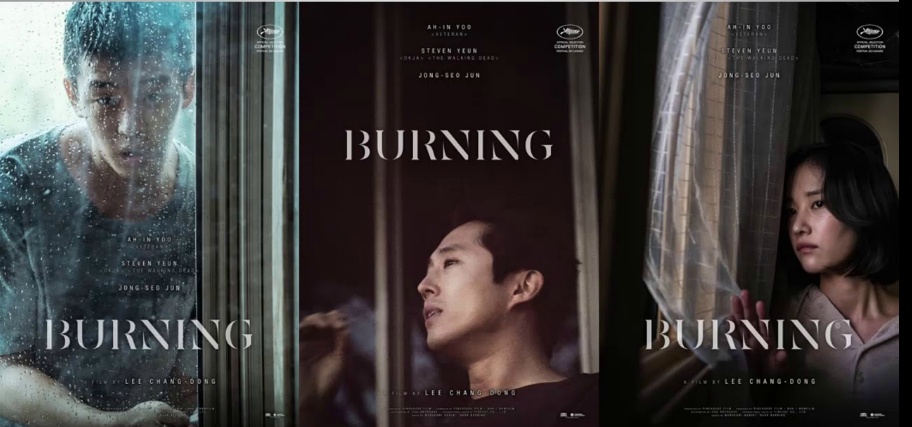
It has been a long time since I watched Burning, but I ended up writing about it rather late. "I wanted to write but kept putting it off" feels like the most fitting way to put it. Honestly I wanted to write, but I also thought it would be good to write after lingering a little in Burning's afterglow and letting my emotions settle. And today just happened to be that day. In this piece I want to talk about 'director Lee Chang-dong', the cinematic techniques, the content, and the thoughts that came to me after watching the film. I didn't write this to interpret the film. I thought of it as a film for which my own thoughts about it matter more.
Among recent films, this was the first time I'd been in a theater with so many people at once. It came with a question: were people really this interested in realist films? Honestly, after a certain point I've just let countless popular films pass by without interest. Black Panther, Avengers, Deadpool, indifference and all—because they were only films with little relevance to my taste. If I had to give a reason, I'd say it's because superhero movies flood the market excessively, like variations on a Cinderella story, repeating the same form until they became tiresome. A day or two would be fine, but watching only that over and over got dull, boring, formulaic, and felt like a waste of money. Finding enjoyment in a predictable narrative was hard for me. Claire's Camera, The Florida Project, and The Shape of Water, which I saw recently, were different from this kind of formula. In subject matter, in story, and Lee Chang-dong's 'Burning', which I saw this time, was the same. As if the emotion of boredom had never existed in the first place, it was an unpredictable film for me
1. The renown of director Lee Chang-dong
Among Korean film directors, I'm not sure where to place the standing that the director 'Lee Chang-dong' occupies. The one thing that's certain is that he's a film director who has pursued 'realism'. Realism has many layers, but he truly pursues 'extreme realism'. He doesn't depict a transformed and distorted reality. Nor does he, like impressionism or romanticism, capture the beautiful or fleeting aspects of reality. Most of his films have depicted life itself. And what's distinctive is that this 'life' belongs not to a cinematic protagonist but to an everyday one.
If we look a little at a few of his earlier films, protagonists like Makdong (Green Fish), Yeongho (Peppermint Candy), Shin-ae (Secret Sunshine), and Mija (Poetry) appear, and the point is that the figures here are 'ordinary'. Just as they were ordinary citizens amid industrialization, or ordinary citizens who lived through May 18. One was also a woman who wanted to write poetry. These films are all richly steeped in Lee Chang-dong's color, having turned everyday protagonists into 'films' as if they were novels. I don't think a director's renown can be measured by 'awards', but precisely because Lee Chang-dong's films are films that must be read like ordinary 'novels', he is all the more a realist director, and his films also swept up awards with each work. It seems that the renown of this director called 'Lee Chang-dong' had an enormous influence on some of the promotion of this film.
However—I'm not sure whether to call it today's film trend—today's film market has become a popular-film market that starkly displays a kind of supply-and-demand curve. I don't watch Avengers and I don't watch Jurassic Park. They're not films from which you can read some message, and they feel like films made to show a kind of visual fun. I think of them as roughly two-hour emotional commodities. But Lee Chang-dong's films are a kind of fine cuisine, too refined to be called emotional commodities. And it's cuisine you don't normally eat, so you don't really know the taste, and you might even feel it tastes bad. Since I've never eaten truffle, caviar, or truffle-mushroom dishes, those would be apt comparisons. When I ate those dishes, could I really feel they were delicious? Probably not. I'd more likely find them strange. It's the same. Despite their high quality, Lee Chang-dong's films aren't to the public's taste. So this 'renown' stands opposed to the film's content and the audience's reception. No matter how expensive truffles and caviar are, the palate of people accustomed to pork belly doesn't change. So with this 'Burning' in particular, I think director Lee Chang-dong's renown actually became poison. In a world utterly transformed by the development of SNS and the internet, Lee Chang-dong's film spread like a trend but never caught fire. Curiously, in 2010, when smartphones were beginning to appear, he showed people 'Poetry', and from then on, during the period when smartphones became widespread and another popular culture was forming, he didn't once work as a director.
2. Cinematic technique
Among films coming out these days, it's rare for one like 'Burning' to continuously expose long takes and montage. Montage is quite a classical technique. The one who first used it in earnest in film was the Russian director Eisenstein. Through montage technique he achieved the conveyance of meaning through the successive arrangement of various objects, doing so suggestively and at the same time elegantly. The problem is that this cinematic technique, 'montage', has become too difficult a technique for today's Korean audiences. As I said earlier, Korean film now is approached through the concept of market supply and demand. It's regarded as a kind of 'entertainment and commodity' on which one can spend time and emotion. Understood not as the art genre called 'film' but as an ordinary consumer good like snacks or coffee. In this situation, a film that conveys a metaphorical and implicit message is an unusual 'beverage'. Just as people choose an Americano or a Frappuccino—direct and undemanding ways of conveying a story—rather than espresso or filter coffee. Just as 'Ben' (Steven Yeun) in the film tells Jong-su not to live too seriously but to feel the bass, the public, like Ben's way of thinking, wants 'to live enjoying' rather than 'a serious life' like Jong-su's. That's why it seems natural to me that many people can't relate to this film. After all, Ben's life is full of riddles, while only Jong-su's repetitive, dull-seeming everyday life is revealed. But director Lee Chang-dong, as in his earlier films, refused to convey the story directly.
Director Lee Chang-dong has long been one of those who showcase cinematic technique well. A representative example would be Peppermint Candy, which shows a reverse-chronological film structure. This film, built in a frame structure, is a truly rare experimental work in Korean cinema. Moreover, fundamentally, 'direct storytelling' is at odds with film and at odds with reality too. Unless it's a film with a narrator, since it's a film that takes the method of merely showing, director Lee Chang-dong simply showed even the protagonist 'Jong-su'. And in the 'realism' needed to show Jong-su, realistic touches appeared in various places through his meticulousness. Jong-su's phone (a Luna), his clothes, the rusty truck, the neglected family home, eating meals, masturbation, looking for the bathroom in Ben's house, and not being able to smoke marijuana, the almost identical clothes, and the job of delivery driver—many such things can be seen as individual devices for realizing the character of Jong-su. But because people these days don't really pay attention to such things, I felt their value had faded.
In my case, if Jong-su had been a delivery driver carrying an iPhone X, I probably wouldn't have been convinced while watching the film. Jong-su is a poor character, and a poor character should carry a phone a poor character might carry, so I'd have wondered how he could use an iPhone X. It would have made no sense for Jong-su, living day to day as a delivery driver, to carry a 1.4-million-won phone. Perhaps that's why I liked the director's realism.
Long takes appear all over the film, so I'm wondering what to talk about, and I think two long takes would be good. One is the dance Hae-mi performs in front of the sunset while thinking of the Great Hunger. If you ask why the Great Hunger, I have nothing to say. But I saw it as Hae-mi having held a desire to escape the Little Hunger to some degree, having that partly resolved through 'Ben', and afterward dancing in the form of the Great Hunger. It's a striking scene in that the Great Hunger appears in the form of a pantomime of a bird in flight, and through the following scene, where the camera directly captures the sky gradually changing from red to blue, it symbolically shows Hae-mi recalling, at Jong-su's house, the happiest time of her life. The other one I can mention is the scene at the end of the film where Jong-su kills Ben.
3. My thoughts
In a postmodern society, judgment is meaningless. So 'conclusions' such as the judgment that Jong-su is right and Ben is wrong, or that Hae-mi did best, are not meaningless, but they cannot point out the right path. They're just one 'path', a direction of life. But if I had to choose between Jong-su's life and a life like Ben's, I don't think I could live like Ben. Ben feels boredom in everything in everyday life and cannot empathize. He's close to a kind of 'floating person' who even comfortably has a meal at an exhibition hall related to the Yongsan disaster that appears in the film. Because I could see points where there's no heat or vitality in life, where everyday life is dull and there's nothing but play, where one cannot shed tears and cannot empathize with others' emotions, I really wasn't drawn to it. If you ask whether I'd want to be reflected as someone who even consumes others' suffering, I would not. He's the kind of person who merely observes and enjoys things but cannot advance to empathy and communication, so I wasn't drawn to it.
But Jong-su's life is a little different. Jong-su's life is clearly poor, but it's a life he's lived trying to understand others at least a little. Watching his father's life, he returns home despite all that happened, and by sending off the 'cow', his father's last asset, he ties up and settles the past. And though it's unseen, he feeds a cat named 'Boil' and trusts others. So I felt Jong-su's life was a bit better. Jong-su's life was a life depicting self-expression through writing novels. At the end, the fact that he chooses Hae-mi's room—'the only place that saw sunlight'—as the space for that self-expression also drew from me a kind of empathy I can't quite name. In Jong-su's figure, symbolizing a harsh life and many of today's young people, there's also that small happy space of Hae-mi's room. Through the scene early in the film of seeing 'sunlight' in Hae-mi's room, Hae-mi's room is revealed as the only space where Jong-su recognizes the emotion of 'happiness', which is why he continually masturbated in Hae-mi's room. But the 'novel-writing' that appears in the latter half of the film, after finishing such masturbation, could be seen as a kind of self-overcoming.
4. To close.
It's a night when the Porsche and the Porter stay in my memory. I don't think I'll be able to forget the Gangbyeon Expressway driving scene.
Comments 0
No comments yet. Be the first.