#AIinterview #videointerview #
1. Motivation: I needed an assessment tool to evaluate the interview ability of a student in my charge, and amid the flood of various interview-assessment tools, I found 'I AM GROUND' — advertised as Saramin's AI interview application — on Google Play, and used it thinking I'd just run an experiment.
2. Observing the student's interview speech from the start, the application analyzed similarly the problems I'd been noticing.
1) The parts that were similar
- Insufficient nonverbal expression: I'd felt the answers were monotonous and unconvincing because the expressions weren't varied; the application analyzed it similarly. The program probably measured the degree of facial-expression change, and in the interviewee's case there wasn't much change in expression.
- Quiet voice: a part that still wasn't well improved even though it needs to be; the program too gave feedback that the voice tends to be quiet.
- Plagiarism rate: actually the part I was most interested in. I used it out of doubt over whether it could verify plagiarism in content. On that point, the app distinguished content plagiarism astonishingly well. Basically, the answers the students prepared this time are very close to highly 'personalized' answers. I found it remarkable that the program picked out that personalized aspect.
When coaching interviews, the easiest method is to 'present the structure first' and then enter and add content, but this method makes it hard to avoid structural plagiarism. No matter the content, if the structure composing it is similar, it sounds similar even with different content, and on that point most interviewees are likely to answer with a 'similar structure.' Take the one-minute self-introduction: starting with the sentence 'I am a person who is like ~~~' can give an excessively cliché impression.
2) The parts I liked
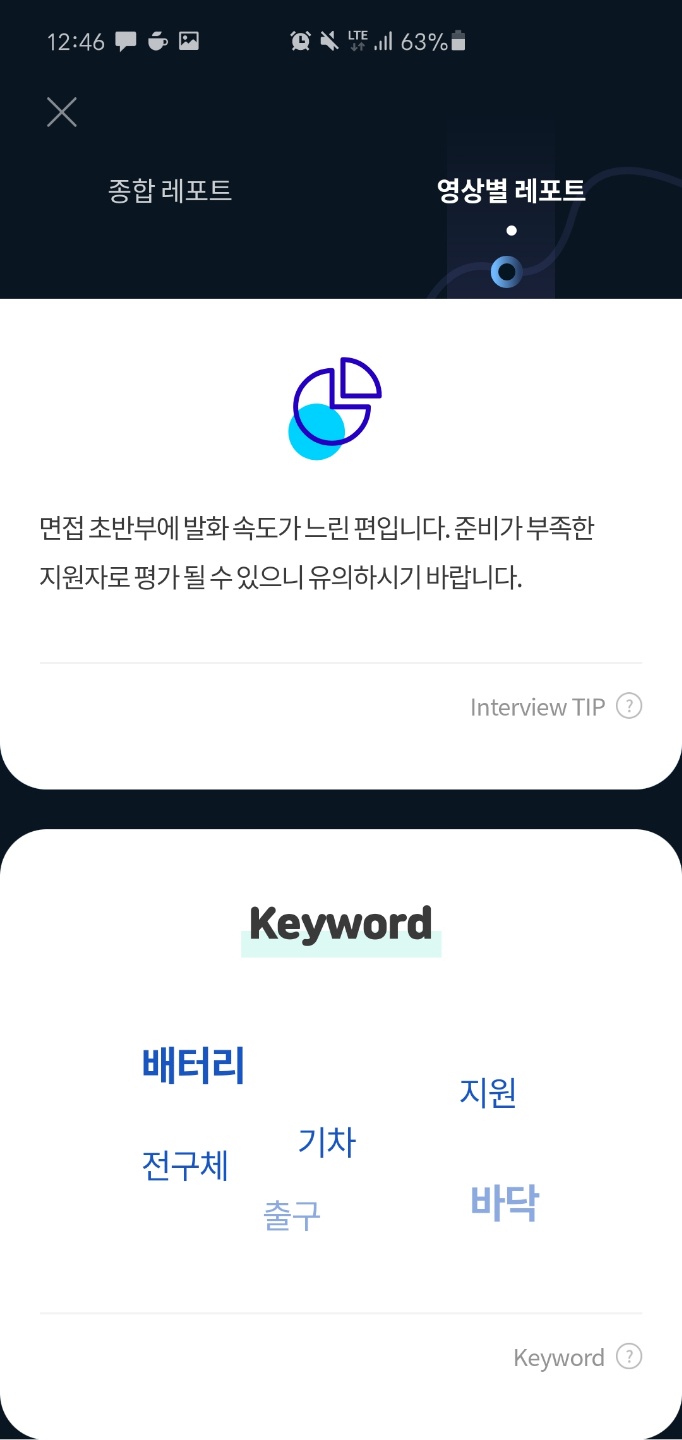
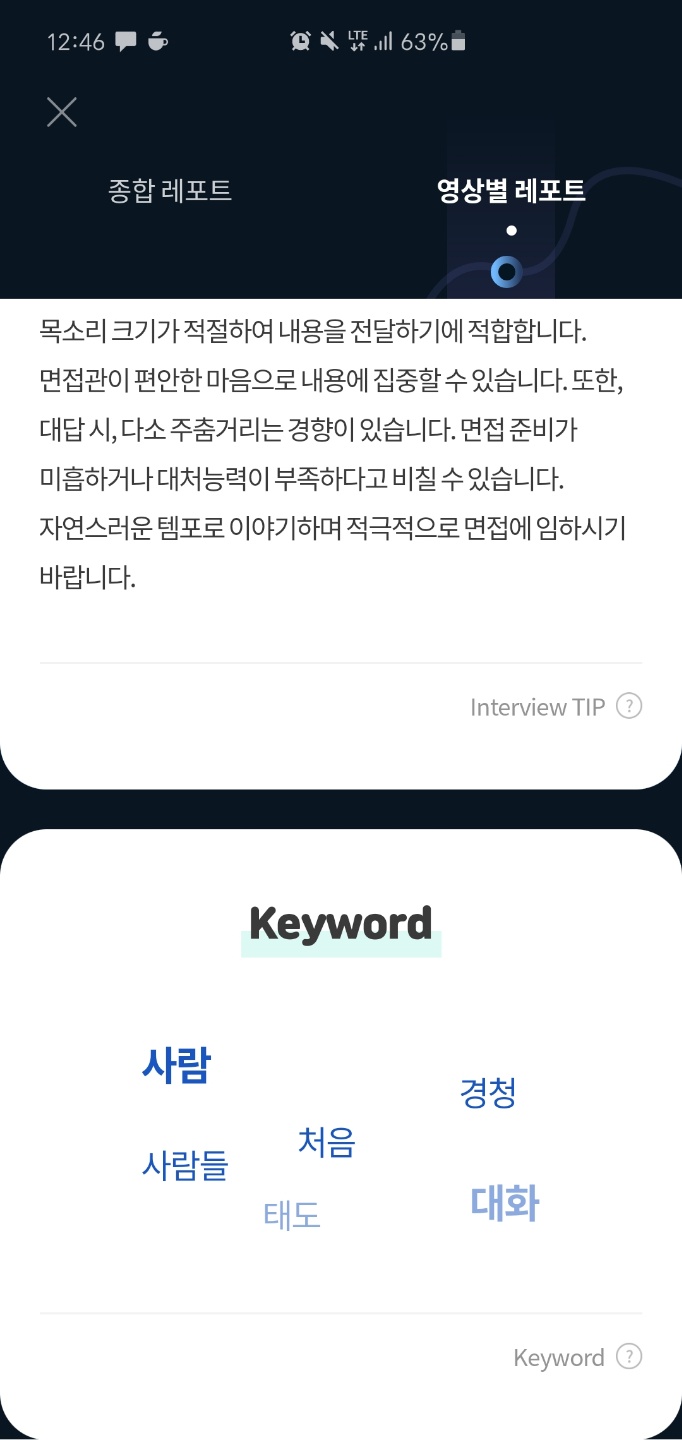
- Keyword summary: analyzing which words you mainly answered with is very similar to the 'morpheme analysis' of existing Korean-corpus analysis solutions, and something similar appeared here, which was impressive. This kind of keyword analysis is one element for checking an interviewee's vocabulary; from the viewpoint of a 'person' giving everyday interview feedback, when varied words are heard repeatedly it's easy to simply give 'this is boring' feedback — and I liked that the app pinpointed that.
3. What other alternatives might there be?
1) IN-air (Midas): this is known as a place that supplies AI interview solutions to companies, and if a school-level partnership with them is possible (through purchasing the solution), practicing with this program isn't bad. However, since the solution's price would be burdensome to approach as an individual, difficulties follow. It's only possible for groups (a group, not a 4-5 person team).
2) Individual interview feedback: paying for feedback can be better. But I think the feel is different in that this isn't a program. AI interviews mostly have the program do the analysis, and the program collects the data with a 'camera.' This process is different from a general interview process, so it can feel unfamiliar, and I think individual interview feedback is hard to support that. If it's going to be that, I wonder whether 'an interview through a study group' isn't better.
* As supporting material, I attach the student's interview result sheet. It was the result of a free trial, and it was offered in the app at a price of about 4,000 won per session.

Comments 0
No comments yet. Be the first.