Sun transit period: Grain Rain - Beginning of Summer - Grain Full (around April 21 to around May 20)
Mother of the gods! You are not a woman,
but the common feminine that exists across the whole earth!
- Mary Elizabeth Coleridge -
1. Introduction
In the figure of Aries we saw the Ram connected to the hidden god, the phallic power and potential, the omnipotence of the 'Father.' But the bull is an animal entirely different from the ram. The bull does not possess a burning fervor; it is material. Though it is related to the fertility of the earth, that is different from the abundant creativity of the heavens.
In Buddhist stories there is one that likens the process of seeking and taming an ox to the 10 stages of attaining Buddhahood, where the human must learn how to tame the stubborn ox and, in the end, both the human and the ox disappear, and one comes to realize that the two were two parts of a sacred union. The bull itself is by no means bad, but if it is allowed to overwhelm the human, he becomes a slave to desire and the bull may drive him to ruin. In this case, repression cannot be the answer. The human and the bull must dance together. Then the two come to respect each other. This Eastern wisdom speaks to the problem inherent in the relationship between ego and desire, and that has become the central task for the personality development of Taurus people.
In this piece we will examine, in sequence, the symbolism of the bull itself and the character of the ruler of Taurus, Venus - the 'ox-eyed' Aphrodite. But before that, let us begin with the story of the bull of Crete, which appears to have a deep connection with the destiny of Taurus people.
-----
2. Myth
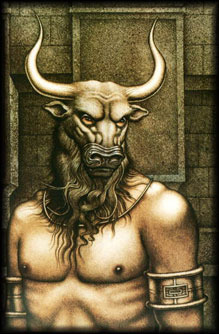
<1> Minos
King Minos is the son of Zeus and Europa, that is, the son of the god (Zeus) who had transformed into a bull. As king of the island of Crete he wielded mighty power, ruling all the islands of Greece and even part of the mainland. In his youth he contended for the throne with his brothers Rhadamanthys and Sarpedon, and claimed his kingship by invoking divine authority. He prayed to Poseidon, the god of the sea who also causes earthquakes, and promised that if a bull were sent from the sea he would immediately capture it and offer it up. Poseidon (who is also depicted in the form of a bull) granted the request, and a bull soon appeared, and Minos came to feel how nice it would be if such a splendid bull were among his own livestock. And so, hoping the god would not mind, he substituted another for the sacrificial bull. He chose the finest of the bulls he owned and offered it to Poseidon as a sacrifice, and put the newly obtained bull into his herd of livestock.
But Poseidon was not one to overlook this, and seeking Aphrodite's cooperation, he made Minos's wife Pasiphae feel an unbearable passion for the bull. Pasiphae, in her single-minded desire to make love with the bull, persuaded the famous craftsman Daedalus to make a hollow wooden form of a cow, then went inside it and, as she had wished, united with the bull. By this was born the terrible monster Minotaur, with the head of a bull and the body of a man, who ate human flesh. Unable to overcome his fear and shame, Minos had Daedalus build a labyrinth and hid this unclean animal there, and each year received seven pairs of young men and women from all over Greece as tribute and threw them in as the monster's food.
This grotesque and terrible story tells us that, although Queen Pasiphae played a role in activating a predetermined fate, the fundamental fault within it lay not with the queen but with Minos himself.
Minos's story ends in a stagnant situation where a terrible monster comes to exist in the very midst of a fertile domain. Such a stagnant situation inevitably brings forth the hero Theseus, who must resolve it. As we saw with Aries, here too we find the irony peculiar to myth. Just like Minos, Theseus too is a child of Poseidon. The creature he must face in the midst of the labyrinth is Minos's sin and the negative, cruel element belonging to his own spiritual father. Thus Minos, the Minotaur, and the hero Theseus are all equally founded on the symbol of the bull.
And in a sense Minos and Theseus form a pair with each other. Because one blasphemed against the god, and the other must atone for it.
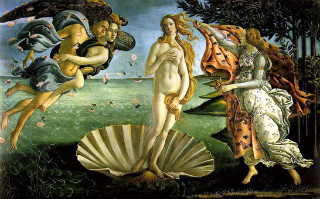
<Aphrodite and the Cow>
Whether we take the bull as our theme or consider the cow as in the myth of Io, we ultimately encounter the animal that is the bovine, and this animal is connected to the goddess Aphrodite, who is said to have 'the eyes of a cow,' and if you know Aphrodite you come to know much about this animal. To encounter this animal and tame it is the destiny of Taurus people.
Aphrodite in fact has a more distinct character than any other Greek goddess. She is not the personification of some vague abstract concept of the universe. She is even now vividly alive, and her existence traces back to the goddess Ishtar of the Babylonian era before Greece, and through the statues of Ishtar we have inherited and the like, her character can be clearly known. She is the symbol of overflowing physical love and is a goddess who knows no hesitation where sex is concerned. On Olympus, where the body itself is regarded as a polluting substance, sex became Aphrodite's portion. This is precisely why she is often depicted nude, in contrast to the other goddesses who are always clothed. She seems to be of a nature that knows no shame even while naked. She also plays the role of intermediary between the world of the immortals and the world of humans. Because, as Zeus does, she too enjoys pairing with humans. A human man who has sexual intercourse with a goddess generally receives death or castration or a punishment beyond. We saw Ixion, who lusted after the goddess Hera, fall into the deepest hell and be bound to an eternally turning wheel of fire. But Aphrodite becomes a lover even to any god or any hero she takes a liking to. She is ever ready to become incarnate and form ties with the human world or earthly things. Humans can look up at her naked form, and thus, unlike gods such as Apollo or Artemis who punish those who come too close to them, she is close to human experience.
Aphrodite governs mutual sexual equality, and exists for the historical moment when the socially dominant view turns in the opposite direction. (Aphrodite (Venus) is explained in relation to Libra, her other ruling sign. Libra and Taurus have a close relationship with each other by the fact that they are jointly ruled by Venus.) She presides over married life, but on the other hand she is also the patron deity of high-class courtesans. Whereas Hera, the queen of the gods, is the symbol of the social system and moral code that stabilizes the institution of marriage, Aphrodite governs the joys and abundance of conjugal love. Desire and satisfaction, procreation, adornment, civilization, beauty, the art of love-making: all of these are under her governance. Her courtship is a refined art and forms a fine contrast to the physical violence or plunder of Ares.
In the myth's cosmogony, Aphrodite had no mother. She was born from the union of the severed phallus of Uranus and the sea. This suggests that, whatever sort of being Aphrodite is, when thought of commonsensically she has little to do with motherhood. It would probably be more apt to say that she loves the physical rapture of married life but does not have the meaning of a wife. Friedrich suggests that she is the most 'solar' of the goddesses.
Artemis and Hera are extremely lunar, the former moving through the bright midnight air and the latter often depicted in the form of a crescent moon. Their symbols have a rich history in the civilization of old Europe, and the moon has a close psychological connection with the general feminine principle such as virginity or menstruation. ( …… ) Among many writings, Aphrodite reveals her explicitness more clearly than any other goddess, and this solar temperament leads to an affinity with gold. Her explicit sexuality forms a great contrast with the secretive, defensive character of Artemis and her hostility toward carnal desire.
-----
3. Summary
The Buddhists' way of understanding seems very apt. Rather than killing the bull, learn how to dance with it within a developmental pattern of mutual respect, so that the bull becomes a bit more human and the human becomes a bit more beast. I have often seen people who, in order to escape the overwhelming threat of sensuality, try to overcome the bull's tireless greed and potential problems by drawing them into the intellect. This, of course, cannot be a solution. Minos too tried it by shutting the Minotaur in the labyrinth, but when that is done, the body usually rebels against the tyranny of the mind. And conversely, I have also seen Taurus people who, becoming slaves to sensuality and the senses, let the bull or cow take precedence over their humanity. But this too satisfies neither the bovine nor the human. Because at this point we return to the situation of King Minos, who, rejecting a truer Self and trying to possess what belongs to another for the sake of private desire, brought about tragic consequences.
But the bull itself possesses both crudeness and elegance, and the aforementioned element is creating the daemon of this unbelievably simple constellation.
Comments 0
No comments yet. Be the first.