Sun transit period: summer solstice - Minor Heat - Major Heat (around June 22 - July 23)
All life came from water.
- the Quran -
1. Introduction
Cancer is, as someone said, the least conspicuous constellation among the zodiac signs. The original image of this humble Crab was not the crab we know as a creature. The Egyptians saw it as the scarab beetle, a dung beetle, and this insect that rolls dung into a ball was for them a symbol of immortality. Called scarab in Egyptian myth, it was believed to be born of itself from within the dung ball, and thus became a being symbolizing self-creation. The name of the god dwelling in this insect was Khephri, meaning 'the one who came from the earth,' and because this beetle pushes a dung ball along just as the sun god crosses the sky rolling a ball of fire, it was identified with Atum the creator, one form of the sun god. The constellation of Cancer itself may be humble, but what it symbolizes carries quite great meaning. The Chaldeans and the later Neoplatonists called Cancer the 'Gate of Men,' through which the soul passes when it descends from heaven to be given a body.
Relating Cancer to such transcendent matters suggests a view of a somewhat different dimension from relating it, in the general astrological tradition, to motherhood, domesticity, food, nurture, protection, and the like. In Egyptian myth, the sun god crosses the sky each day in a golden boat, then descends into an underground cave, fights a fearsome serpent, wins, and rises again in the east at dawn to begin a new day. This mystical concept relating Cancer to the source and seed of life leads not only to the primordial mother imagined in general astrology but also to the father. Because what this myth speaks of relates not only to coming out of the womb but also to the seed of the soul being conceived and beginning a new life. I have often seen this element working strongly in the lives of Cancer people. This view can be said to connect with Cancer's association with motherhood, private life, and so on.
-----
2. Myth
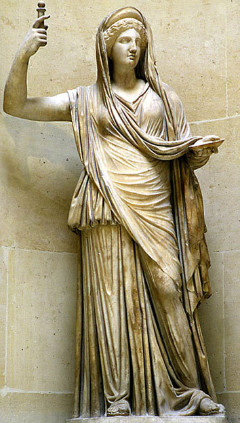
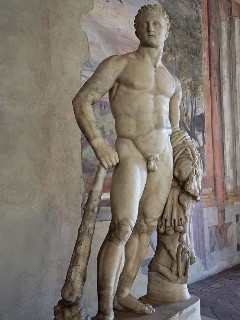
<Hera> <Heracles>
<Heracles and the Crab>
The Greek myth about Cancer develops more toward the maternal. The Cancer tale included in Heracles' twelve labors goes as follows. While Heracles was fighting the nine-headed serpent Hydra that lived in the region of Lerna, all the creatures around took the hero's side. Just then a great crab crawled out of the swamp where Hydra lived and snapped at Heracles' heel with its pincers; this crab had been sent by the goddess Hera to hinder him. Receiving this classic Cancer-type attack, Heracles nearly lost his original opponent for a moment, but in the end stomped the crab to death. Afterward Hera, to commend the crab that had faithfully carried out her command, is said to have made it a constellation in the sky.
The meaning of the word 'Heracles' is, ironically, 'the glory of Hera.' Hera's curse is, on the surface, because another wife of Zeus bore him. But to tell the truth, this is the expression of the matriarch's wrath at the impudent hero who threatened her law. Cancer certainly has a negative aspect reflecting this kind of problem, and the struggle to become free from the mother's sphere of influence frequently emerges as an important and difficult problem for Cancer people. The Cancer here holds purely the symbol of motherhood, and the father has meaning only as a supplier of seed. This regressive element inherent in the Cancer-born personality rather confines them in a cave, against the consciousness-raising and freedom of choice that the ego demands. It resembles the archetypal 'Terrible Mother' holding her child so it can't escape her embrace, or killing the child rather than letting it go. The crab in the myth doesn't face its enemy fair and square but bites his foot while he fights another opponent, taking the underhanded approach that is Cancer's negative trait. This is a negative aspect of Cancer that the heroic element existing within the individual must definitely become conscious of and overcome. What Hera's crab signifies is not necessarily only feminine. Because this crab lies deeply latent in the personality of every man and woman in whose natal chart Cancer is especially prominent. Cancer-born men generally experience considerable difficulty regarding their masculine image. Because male heroism tends to idealize the rough, aggressive, and fierce, and Cancer is far too distant from that.
Thus we can illuminate Cancer from two perspectives: that of the 'Terrible Mother' image, which tries to retain dominion over a not-yet-mature individuality, and that of the 'Divine Father' image as the source of life the individual yearns for. Erich Neumann, in his book 'The Origins and History of Consciousness,' explains that such cosmic parents are two aspects of a single body, appearing as hermaphroditic to the primordial child's mind and symbolized over long ages by the Uroboros. This Uroboros is the oldest symbol concerning humanity's origin; it sprang from the primeval depth where this world and the soul are one, where the question about the world's origin connects directly with the question about one's own origin, the origin of consciousness, and the origin of humanity.
This powerful symbol is the answer that sprang, in response to the question 'where did I come from?', from that deep place where mother and father were one. It is the primordial completeness before relativity and struggle began, before the egg hatched and a world was formed. Therefore the Uroboros is the first creative factor (what Jung called the sea of the collective unconscious) that ceaselessly kills, marries, and conceives itself.
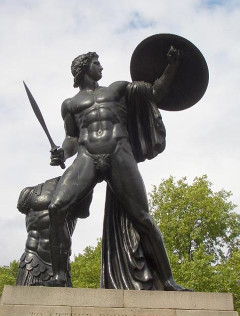
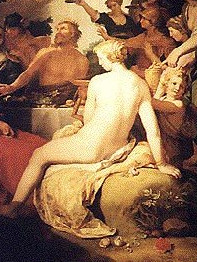
<Achilles> <Thetis>
<Thetis and Achilles>
The ocean as the source of life is ruled by the sea goddess Thetis. Thetis is the Creatrix. Her name, Thetis, comes from the word tithenai. Thetis is not only a god but water itself, and long before the Hebrew Yahweh existed, she existed, holding within her depths the male and female, seed and womb. She is also called Nereis, a word meaning 'the element of water.'
Her creative power, because of a prophecy about her, had to be realized only through human consciousness and human expression. This seems to align with something Jung said — namely, that the evolution of the psyche is impossible on its own and occurs through interaction with the ego. Jung quotes the writing of the 17th-century mystic Angelus Silesius.
I know
that without me God cannot live a moment.
If I should perish,
then He too could no longer survive.
Without me God
cannot create even a single worm.
If I do not stand with Him,
His fate is to perish.
I am as great as God,
and He is as small as I.
He cannot be above me,
nor I beneath Him.
I am God's child and His son,
and He too is my child;
we are two within one,
father and son at peace.
Thetis comes to marry the mortal Peleus, and from that bears Achilles. This hero was a great figure who showed all the traits of Cancer to the letter. Graves described Achilles, sulking and holed up in his tent before the walls of Troy, with the word 'hysterical,' and Homer's Iliad tells that Thetis, to keep her son from being drawn into the war, dressed him in women's clothes and hid him among women.
Achilles is a hero with a somewhat strange background. About his fate there was a prophecy that he would either win great glory and die young, or live long at home without any glory. Achilles himself chose the former, and he staked death as collateral for becoming free from the goddess's domain. When Cancer people make such a decision, they can exercise the possibility of creative imagination. But in the world there are far more people who remain in the comfortable embrace of the 'mother.'
The single factor that could make the sulking Achilles burst out of his quarters and run back to the battlefield was the death of his dearest friend Patroclus. Only through such a factor could his true zeal and courage well up. This too speaks to one side of the Cancer-born: that only over a deep emotional loss will they throw themselves into life's struggle.
-----
3. Summary
Whatever form of mother a Cancer person envisions, he is always bound to her, through good or evil. The negative side of this daimon is that, through excessive bonding with the mother, it paralyzes and suffocates the individual's capacities, preventing their expression. And the positive side is that the individual can act as midwife to unconscious images. The problem of becoming independent from the mother will be a crucial turning point in Cancer people's lives, and it's not something that ends in a single instance but must be undergone many times, on many levels. Like the actual crab that must always stay near both water and land, these people are urged to settle in the real world with one foot forever dipped in water. And so in the end they may themselves become the womb through which the children of the sea are reborn.
Comments 0
No comments yet. Be the first.